
Reading Time: 19 minute(s)
Inflatable car paint booths offer a practical solution for achieving controlled, dust-free paint environments without the expense and space requirements of permanent spray booths. Designed for mobile detailers, small shops, and DIY enthusiasts, these portable structures create a contained workspace that improves finish quality by minimizing contaminants and allowing consistent airflow and filtration. Easy to set up and transport, inflatable booths adapt to different vehicle sizes and job sites, making them ideal for on-location repairs, custom paint jobs, or seasonal overflow at busy shops. Many models include integrated lighting, ventilation, and HEPA filtration to ensure cleaner results and faster curing times, while also reducing overspray and environmental exposure. For professionals focused on delivering reliable, repeatable finishes, investing in an inflatable paint booth can streamline workflow, protect workmanship, and elevate the overall presentation of automotive detailing services.
Table of Contents
- Why a portable inflatable car paint booth for mobile auto detailers Improves Finish Quality and Job Efficiency
- How an enclosed inflatable workspace boosts finish quality by controlling dust, debris, and contaminants for smoother paint and clear coat results
- Quick setup and teardown: portable paint booth benefits for mobile auto detailing equipment and flexible job scheduling
- Ventilation, filtration, and safety considerations to maintain airflow, manage overspray, and protect technicians during painting and curing
- Visibility, access, and durability: design features that improve efficiency for touch-ups, full resprays, and repeatable refinishing tasks
- Key Features to Look For in an inflatable spray booth for vehicle touch-ups and clear coats: Ventilation, Filtration, Lighting, and Access
- Ventilation Strategies for Safe Paint Application: Choosing Inflatable spray booth ventilation systems, exhaust placement, and airflow patterns to control fumes and ensure proper curing
- Filtration and Overspray Management: Evaluating paint booth filtration efficiency, filter types, and maintenance to protect finishes and reduce cleanup
- LED Lighting and Visibility Considerations: Optimal led lighting for vehicle painting, placement, color temperature, and windowed sections for accurate color matching and defect spotting
- Access, Sealing, and Workspace Layout: Door and access panel design, sealing methods to keep contaminants out, and interior organization for tools, staging, and safe movement during touch-ups and clear coats
- Who Benefits Most: Mobile Detailers, Small Shops, and Enthusiast DIYers
- How mobile car detailing services gain from a portable inflatable paint booth: cleaner sprays, faster setup, and on-site finish control
- Small shops and part-time bodywork businesses: maximizing limited space with temporary controlled spray areas and filtration
- Enthusiast DIYers and hobbyists: improving DIY car care techniques for touch-ups, clear coats, and smoother results at home
- Operational considerations for businesses: ventilation, lighting, and workflow adaptations to integrate a portable booth into an auto detailing business
- Safety, Setup, and Practical Considerations for Safe Painting, Curing, and Overspray Management
- Respirator selection and fit-testing: choosing the right RPE for painting and cure operations inside an inflatable paint booth
- Ventilation and solvent vapor control: configuring extraction, filtration, and airflow to manage fumes, overspray containment methods, and safe cure schedules
- Setup best practices and physical safety: anchoring, lighting, entry/egress, fire prevention, and maintaining a clean workspace during spraying and curing
- Key Takeaways
Why a portable inflatable car paint booth for mobile auto detailers Improves Finish Quality and Job Efficiency
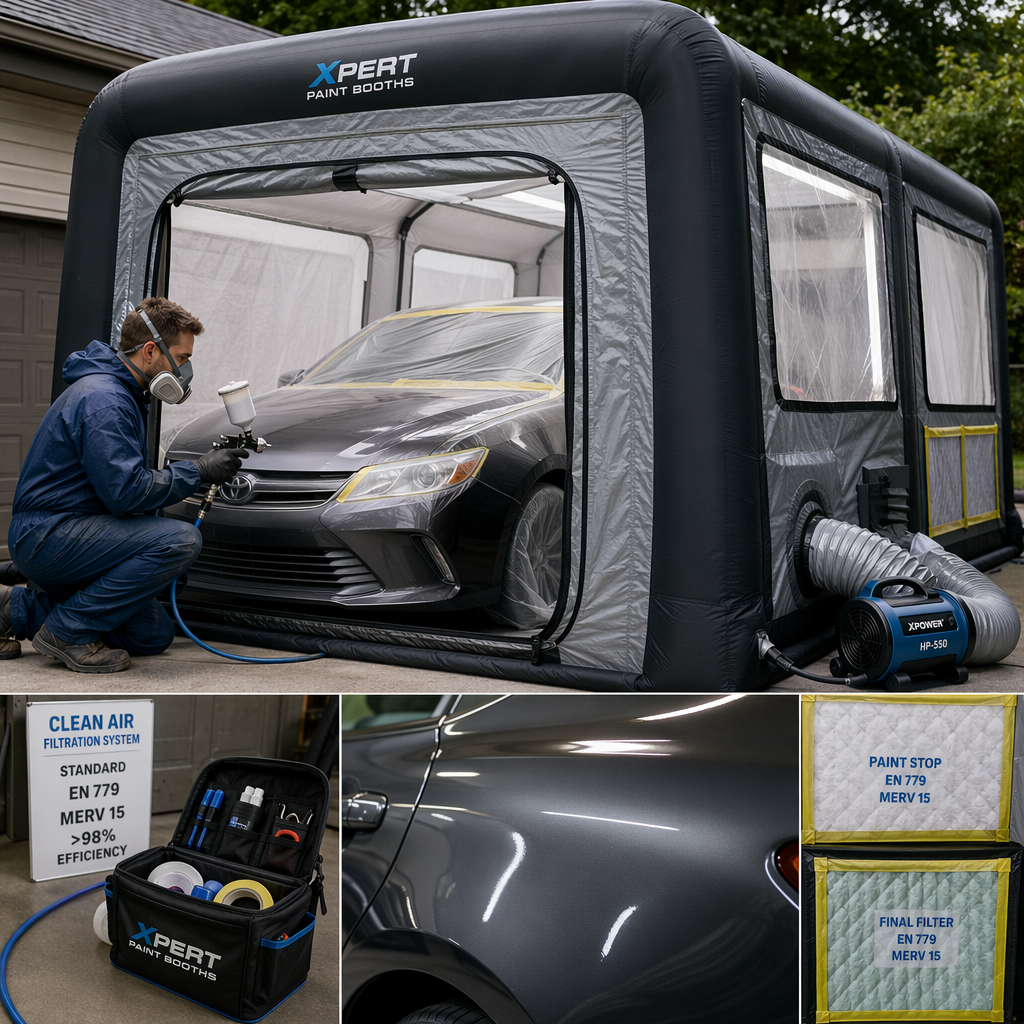
How an enclosed inflatable workspace boosts finish quality by controlling dust, debris, and contaminants for smoother paint and clear coat results
An inflatable paint booth creates a stabilized, enclosure that markedly reduces particulate intrusion and surface contamination, enabling technicians to achieve crisper edges and glossier clear coats. Mobile detailers benefit from rapid deployment and modular ventilation that manage overspray and solvent-laden atmospheres, while retaining portability for multi-site work. Controlled airflow diminishes orange peel and fisheye defects by evacuating airborne debris and maintaining laminar conditions near the panel. Durable, chemical-resistant fabric and optional windowed panels improve illumination and ergonomics during complex refinishing. Prioritize appropriate extraction and PPE to ensure safety, and pair with suitable filtration to optimize curing and minimize rework. inflatable paint booth
Quick setup and teardown: portable paint booth benefits for mobile auto detailing equipment and flexible job scheduling
The portable inflatable paint booth transforms on-site refinishing by giving technicians a controlled microenvironment that markedly improves finish quality. By isolating the vehicle from ambient dust, pollen and wind-driven particulates, the booth reduces common defects like orange peel, fisheyes and dust nibs. Rapid inflation and collapse enable technicians to pivot between jobs and locations, increasing throughput without the capital outlay of permanent infrastructure.
Its modular design accommodates variable vehicle sizes, and integrated ventilation with appropriate filtration maintains laminar airflow during spraying and curing, safeguarding both finish and operator. Transparent panels provide natural light while preserving enclosure integrity, and robust materials resist solvent vapors for repeated use. Portable usage suits mobile detailers, hobbyists, and small shops that require ephemeral, high-quality spray environments. Practical diligence—adequate extraction, PPE and lighting—complements the system to yield consistent, salon-grade results with enhanced operational agility and reduced rework rates.
Ventilation, filtration, and safety considerations to maintain airflow, manage overspray, and protect technicians during painting and curing
An inflatable car paint booth creates a controlled microenvironment that markedly elevates finish quality and streamlines workflow for mobile auto detailers. By isolating the vehicle from ambient dust, pollen, and particulate fallout, the booth reduces surface contaminants that cause fisheye, orange peel, and other defects. The enclosure also stabilizes local airflow, enabling even solvent evaporation and more consistent film formation during basecoat and clearcoat applications.
Ventilation strategy is pivotal: balanced intake and extraction, coupled with high-efficiency filtration, remove overspray and maintain laminar-like flow without turbulence. Use of cartridge or HEPA-style filters mitigates airborne particulates, while activated carbon layers help adsorb volatile organic compounds during cure cycles. Safety protocols must prioritize respiratory protection, grounded power sources, and spark-free lighting to prevent ignition of flammable vapors.
Portability allows technicians to deploy a compliant spray zone wherever needed, reducing transit of partially finished panels and minimizing contamination risk from moving parts. Transparent panels provide task lighting and visual assessment without opening the enclosure, preserving the sanitized atmosphere. Consider material chemical resistance, anchor points for secure setup, and integrated ducting for extraction equipment. Inflatable paint booth solutions offer a pragmatic, transient alternative to permanent spray rooms while advancing paint uniformity and operational efficiency.
Visibility, access, and durability: design features that improve efficiency for touch-ups, full resprays, and repeatable refinishing tasks
An inflatable paint booth creates a controlled microenvironment that markedly enhances finish consistency and reduces particulate contamination during painting and curing. Mobile detailers benefit from rapid deployment, modular access points, and transparent panels that afford superior visibility for precision work and feathered touch-ups. Robust fabric and integrated ventilation with particulate filtration mitigate overspray and solvent vapor buildup, promoting even drying and fewer defects. The portability facilitates repeatable refinishing across varied sites while conserving shop footprint and amortizing equipment costs. Proper airflow management and auxiliary illumination preserve optimal surface tension and gloss uniformity, making the inflatable paint booth a pragmatic refinement tool.
According to the Automotive Refinish Industry Standards published by the Society of Motor Manufacturers and Traders, proper controlled-environment spray booths with balanced ventilation and high-efficiency filtration significantly reduce particulate contamination and solvent-related defects, improving overall finish quality and reducing rework for mobile and fixed refinish operations.
Key Features to Look For in an inflatable spray booth for vehicle touch-ups and clear coats: Ventilation, Filtration, Lighting, and Access
Ventilation Strategies for Safe Paint Application: Choosing Inflatable spray booth ventilation systems, exhaust placement, and airflow patterns to control fumes and ensure proper curing
An inflatable paint booth creates a controllable microenvironment that markedly improves finish consistency during touch-ups and clear coats. Prioritize robust ventilation that forces contaminated air away from the workpiece while supplying laminar airflow; this reduces orange peel, fisheye, and particulate nibs. Strategically positioned exhausts at low points combined with intake ports near the top promote a downward displacement pattern, flushing heavier overspray and solvents out efficiently. Filtration is pivotal: use multilayer intake prefilters to trap dust, and high-efficiency exhaust filters or cartridge systems to capture fine aerosols and reduce ambient contamination. Consider activated-carbon stages when working with solvent-borne products to mitigate VOCs and olfactory fatigue. Lighting should be integrated through translucent panels or windowed sections to maintain color fidelity and reveal surface defects; a mix of diffuse overhead illumination and portable task lamps yields the best inspection angles.
Access design matters for workflow — wide zippered portals for vehicle ingress, glove ports for detail tasks, and service flaps for hoses and cables minimize breaches in containment. Ensure the blower delivers constant CFM compatible with the booth volume and that seals are resilient to solvent exposure. Combining optimized airflow, filtration, illumination, and pragmatic access yields a portable booth that supports professional-grade refinishing and safer paint application.
Filtration and Overspray Management: Evaluating paint booth filtration efficiency, filter types, and maintenance to protect finishes and reduce cleanup
Effective ventilation and robust filtration are essential for a controlled finish; choose high-efficiency particulate filters and activated carbon layers to trap overspray and volatile compounds. Ensure extractors maintain laminar airflow and negative pressure. Regular filter swaps and booth purge cycles prevent contamination buildup, preserving a pristine surface and minimizing corrective rework. filtration
LED Lighting and Visibility Considerations: Optimal led lighting for vehicle painting, placement, color temperature, and windowed sections for accurate color matching and defect spotting
An effective inflatable paint booth hinges on airflow, filtration, illumination and access to ensure professional-grade results. Prioritize a system with adjustable ventilation and HEPA-grade filtration to control overspray, particulates and solvent-laden vapors, creating a contaminant-free microclimate around the vehicle. Well-planned ingress and egress points with sealable flaps preserve pressure balance and simplify moving panels or doors during multi-stage refinishing.
LED placement is pivotal: mount diffuse, shadow-minimizing panels along the ceiling and sidewalls to reveal orange peel, runs and dust nibs without glare. Aim for neutral color temperature near 5000–6500K for accurate matching and consistent cure perception. Windowed sections or translucent panels supplement LEDs, offering ambient inspection light while maintaining enclosure integrity.
Durable, solvent-resistant fabrics and reinforced seams extend service life, while strategically positioned access ports for hoses and tools maintain ergonomics. Combining these elements yields a portable workspace that reliably elevates paint quality and reduces rework.
Access, Sealing, and Workspace Layout: Door and access panel design, sealing methods to keep contaminants out, and interior organization for tools, staging, and safe movement during touch-ups and clear coats
When assessing an inflatable spray booth for vehicle touch-ups and clear coats, prioritize a robust balance of airflow management, particulate control, and operability. Effective ventilation systems ensure turbulent-free air displacement during spraying and curing; combine directional airflow with adjustable speeds to avoid film defects and orange peel. Filtration should include both intake and exhaust stages, with HEPA or high-efficiency media to trap overspray and solvent mists while protecting ambient air. Adequate luminance is essential: translucent panels or integrated LED arrays reduce shadowing and reveal surface irregularities during wet-sanding and clear-coat application.
Door and access panel design governs workflow and contamination control. Rapid-seal zippers, overlapping flaps, and magnetic closures create airtight transitions that limit dust ingress when technicians move in and out. Consider dual-access arrangements for tool transfer and emergency egress. Sealing methods extend to the floor interface; weighted hems or inflatable skirts maintain a consistent seal on uneven ground and prevent particulate migration under the booth.
Interior organization enhances safety and throughput. Modular mounting points, retractable tool tethers, and anti-static tie-downs keep sprayers, hoses, and lighting neatly stowed while reducing trip hazards. Staging zones for primed, painted, and curing panels help maintain solvent partitioning and minimize cross-contamination. Use purpose-specific fixtures to hold doors and mirrors at fixed angles during spray sequences.
Overall, the most important consideration is ventilation because controlled airflow underpins paint quality, worker safety, and regulatory compliance, making it the decisive factor in selecting and configuring a portable inflatable paint enclosure.
For deeper guidance on ventilation rates, solvent control, and occupational exposure limits that inform inflatable spray booth design and safe operation, consult the publication from the University of California, Berkeley Center for Occupational and Environmental Health which outlines engineering controls, capture velocities, and filtration efficacy pertinent to spraying operations; their recommendations on laminar flow strategies and particulate capture help translate theory into pragmatic booth configurations and maintenance intervals https://coeh.berkeley.edu/targeted-topics/air-sampling-and-control/ventilation/targeted-topics-ventilation/targeted-topics-ventilation-spray-booths/
Who Benefits Most: Mobile Detailers, Small Shops, and Enthusiast DIYers
How mobile car detailing services gain from a portable inflatable paint booth: cleaner sprays, faster setup, and on-site finish control
Mobile detailers, compact body shops, and dedicated hobbyists find tangible gains from using an inflatable paint booth: it fosters a controlled environment that reduces particulates and feathering, yielding a more uniform finish. Setup is swift, often under an hour, enabling rapid deployment for on-site repairs or sequential jobs. The enclosure shields work from errant wind and airborne contaminants while offering configurable ventilation and filtration to manage overspray and solvent vapors. Portability means adaptive workflows and reduced capital outlay compared with fixed booths. Practical considerations include ensuring adequate illumination, secure anchoring, and adherence to respiratory and fire-safety protocols for safe, repeatable refinishing outcomes.
Small shops and part-time bodywork businesses: maximizing limited space with temporary controlled spray areas and filtration
Mobile detailers, small body shops, and dedicated hobbyists gain substantial advantages from an inflatable paint booth that converts any available space into a controlled finishing environment. The portable structure curtails airborne particulates and turbulence, yielding a markedly smoother clear coat and fewer fisheyes or orange peel defects. For part-time bodywork operations this means optimizing limited square footage without permanent construction, while mobile pros appreciate rapid deployment for on-site refinishes and spot repairs. Enthusiasts achieve near-professional results at home, benefitting from consistent airflow management and temporary containment during solvent-laden cures. Practicalities such as integrated filtration, proper illumination, and safe exhaust routing are essential to preserve air quality and worker safety. Lightweight yet resilient fabrics resist paint vapor degradation, enabling repeated use across varied locales. The inflatable booth’s chief asset is flexibility: a configurable, contaminant-reduced workspace that elevates paint quality and streamlines workflow for operators balancing mobility, cost-efficiency, and meticulous surface preparation.
Most important keyword: inflatable paint booth
Enthusiast DIYers and hobbyists: improving DIY car care techniques for touch-ups, clear coats, and smoother results at home
For mobile detailers, small shops, and enthusiast DIYers, an inflatable paint booth elevates routine refinishing tasks into precision work by providing a controlled microenvironment that curtails particulate intrusion and turbulent airflow. The portability and rapid deployment let mobile technicians set up a sterile workspace virtually anywhere, transforming a curbside touch-up or on-site respray into a process with far fewer contaminants and less rework. Hobbyists benefit similarly: treating a garage corner with a temporary enclosure yields markedly smoother clear coats and sharper feathered edges compared with open-air attempts.
Practical advantages include simplified masking, the ability to stage lighting through windowed panels, and modular filtration options that manage overspray and vapors without permanent ductwork. This makes it feasible to perform color corrections, spot repairs, and full-panel resprays with professional-grade outcomes.
Safety and efficacy hinge on adequate ventilation, compatible extraction units, and conscientious use of personal protective equipment; these measures mitigate fume accumulation and ensure consistent cure conditions. Space-limited shops gain flexibility too, since the booth collapses for compact storage and redeployment during peak workloads.
Because the apparatus isolates the workpiece from environmental contaminants, it reduces orange peel, fisheyes, and dust nibs, while preserving crisp edges and uniform gloss. For enthusiasts experimenting with advanced coatings or metallic flakes, the controlled atmosphere markedly improves atomization consistency and finish homogeneity. The most important consideration for anyone using this solution is the inflatable paint booth, which combines convenience, contamination control, and adaptability to produce higher-quality automotive refinishing outcomes.
Operational considerations for businesses: ventilation, lighting, and workflow adaptations to integrate a portable booth into an auto detailing business
Mobile detailers, small shops, and dedicated DIYers gain measurable advantages from a portable inflatable paint booth that establishes a contaminant-free microenvironment for refinishing tasks. Rapid deployment and compact stowage enable on-site operations or flexible garage use, while integrated filtration and extraction modules mitigate volatile organic compounds and overspray particulates. Ensure laminar airflow paths and task-specific luminance to avoid sags or orange peel during curing.
Operationally, reconfigure workflow to include staged entry/exit, tack-cloth stations, and tool ports to maintain cleanliness. Prioritize ignition control and compatible PPE, and validate booth anchoring to resist wind shear during extended bake cycles.
Safety, Setup, and Practical Considerations for Safe Painting, Curing, and Overspray Management
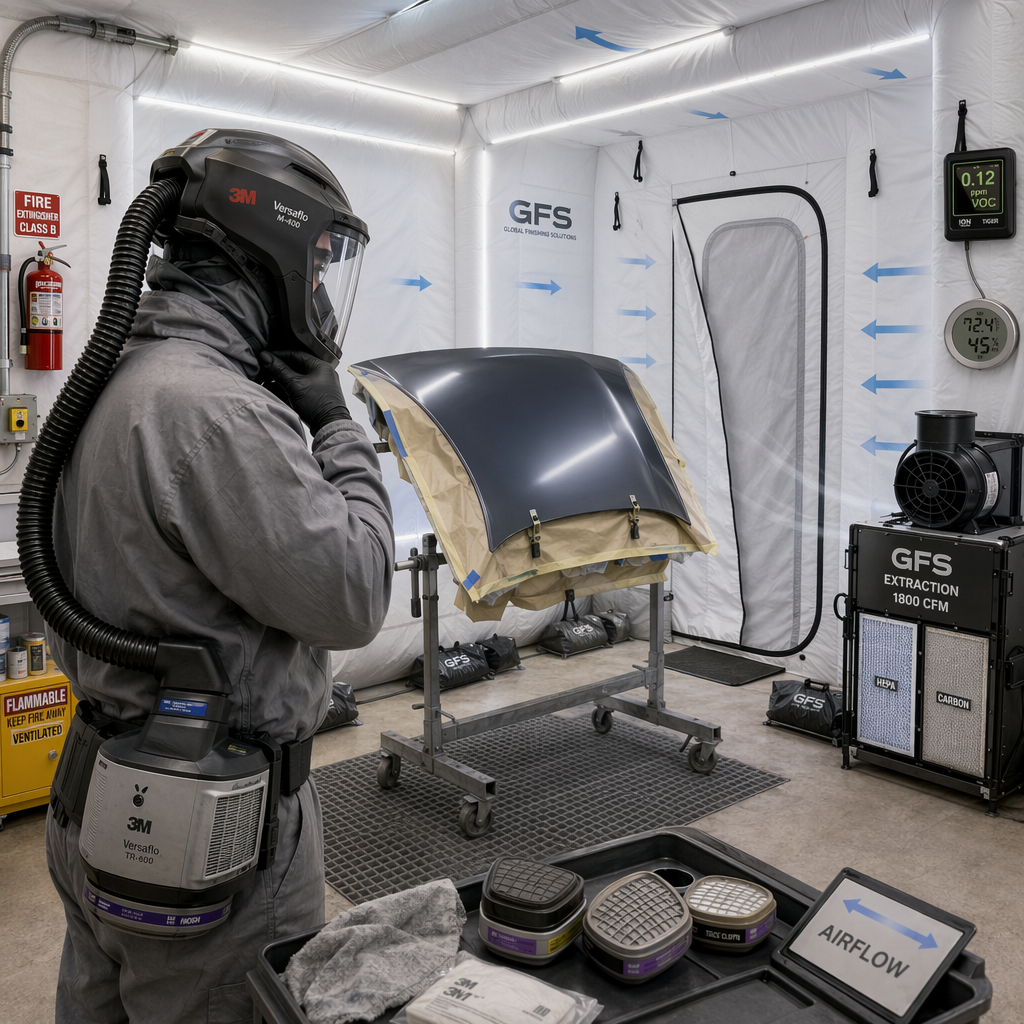
Respirator selection and fit-testing: choosing the right RPE for painting and cure operations inside an inflatable paint booth
When using an inflatable paint booth, selecting and fit-testing the correct respiratory protective equipment is essential to prevent inhalation of solvent vapors, isocyanates, and fine particulates. Start with a risk assessment to determine required protection level; many paint operations demand at least a PAPR or a full-face respirator with organic vapor cartridges and particulate filters. Proper fit-testing—qualitative or quantitative—verifies a seal and is non-negotiable for full-face masks. Check compatibility with helmets, eye protection, and cooling systems commonly used in confined inflatable spaces. Replace cartridges and filters per manufacturer schedules and after high-exposure tasks. Ensure breathable air standards if using supplied-air systems, and maintain donning/doffing protocols to avoid contamination transfer. Ventilation efficacy within the enclosure influences respirator choice; less-effective extraction may necessitate higher protection. Train personnel on alarm response for PAPR failures and perform routine seal checks. The most important keyword is respirator.
Ventilation and solvent vapor control: configuring extraction, filtration, and airflow to manage fumes, overspray containment methods, and safe cure schedules
Creating a safe inflatable paint booth requires attention to ventilation, solvent control, and overspray containment. Use a rated extraction fan and modular filtration to establish directional airflow and capture particulates; ensure positive or negative pressure as job demands. Monitor volatile organic compounds and schedule curing during low-humidity windows to prevent blush and solvent entrapment. Employ tack mats, drop zones, and overspray curtains for particulate segregation. Maintain explosion-safe electrical fittings and grounded equipment to reduce ignition risk. Regularly inspect seals and fabric integrity to preserve a contaminant-free envelope. The central operational focus is ventilation, which dictates finish quality and worker safety.
Setup best practices and physical safety: anchoring, lighting, entry/egress, fire prevention, and maintaining a clean workspace during spraying and curing
Establish a methodical approach to anchoring and positioning the inflatable paint booth to prevent wind uplift and ensure dimensional stability; sandbags, ground stakes, or weighted racks work well. Provide redundant egress points for rapid exit and equip them with smooth zippers or flaps to avoid snags. Illuminate the interior with diffuse, vapor-rated lighting to reduce shadowing and color misperception while minimizing heat buildup. Maintain a sanitary work envelope by instituting tack-cloth passes, anti-static treatments, and a scheduled particulate sweep between coats.
Fire prevention is paramount: use intrinsically safe electrical fittings, keep flammable solvents in ventilated lockers, and deploy an appropriate extinguisher rated for solvent fires. During curing, run controlled ventilation with suitable filtration to evacuate VOCs and overspray aerosols while preserving laminar flow. Monitor atmospheric conditions with a hygrometer and PID sensor if possible. Finally, document standard operating procedures and wear recommended PPE to reduce inhalation and dermal exposure during painting and post-application handling.
Key Takeaways
An inflatable paint booth offers mobile detailers, small shops, and enthusiasts a portable controlled environment that reduces particulate contamination, overspray and solvent exposure to produce smoother basecoats and glossier clear coats. Key benefits include fast setup and teardown, modular sizing for varied vehicles, translucent panels and LED lighting for accurate color matching, and durable, solvent-resistant materials for repeated use. Proper ventilation, balanced intake and extraction, multilayer filtration and activated carbon stages manage fumes and maintain near-laminar flow to minimize defects like orange peel and fisheyes. Safety and operational best practices cover respirator selection and fit testing, explosion-safe electricals, anchoring and sealed access panels, plus routine filter maintenance and purge cycles. Interior organization, seal strategies and workflow staging further reduce rework and improve throughput. For anyone seeking higher quality mobile refinishing without permanent infrastructure, an inflatable paint booth combines contamination control, portability and configurable ventilation to deliver consistent, professional-grade results while emphasizing respiratory protection and safe curing procedures.