
Reading Time: 19 minute(s)
Bring energy and excitement to backyard gatherings with an inflatable bounce house featuring an integrated slide and spacious jump area, designed for durable play. Constructed from heavy duty PVC, reinforced seams resist wear and tear while providing a stable surface for repeated use. Safety netting around the perimeter keeps children visible and contained, reducing the risk of accidental falls during energetic activity. Simple setup and reliable inflation mechanics mean parties spend more time playing and less time troubleshooting equipment. The combination of slide and bouncy area offers varied activity to keep kids engaged for hours, making it an ideal centerpiece for birthdays, family reunions, or neighborhood events. Easy to clean and built for portability, this bounce house balances robust construction with practical design, ensuring hosts can focus on fun while offering a dependable and safe play environment for young guests.
Content Summary
- Durable PVC Inflatable Bounce House With Slide And Safety Netting For Backyard Parties: Materials, Reinforced Seams, And Longevity
- Heavy-Duty PVC Construction and Long-Lasting Commercial-Grade Vinyl: Material Choices That Ensure Durability and Tear Resistance
- PVC Reinforced Seam Durability: Welding, Double-Stitching, and Patch Strategies to Prevent Leaks and Extend Lifespan
- Integrated Slide and Jump Area Design: Load Distribution, Impact Zones, and Reinforced Flooring for Energetic Play
- Safety Netting Placement and Visibility: Preventing Falls, Maintaining Airflow, and Meeting Backyard Slide Safety Netting Standards
- Easy Setup Inflatable Bounce House With Reinforced Seams And Secure Inflation System: Step-by-Step Assembly, Maintenance, And Deflation For Storage
- Step-by-Step Assembly Guide: Secure Inflation Safety Guidelines, Anchoring, and Initial Inspection Before First Use
- Reinforced Seams: Pre-Use Checks, Minor Repairs, and When to Use a Reinforced Seam Repair Kit
- Daily Operation and Supervision Protocols: Safe Capacity Limits, Netting Checks, and Handling Energetic Play
- Deflation and Storage Procedure: Proper Drying, Rolling Techniques, and Long-Term Care to Preserve Durable PVC Construction
- Safety Features And Supervision Best Practices For Safe Energetic Play In Jump Areas And Slides
- Establishing Supervised Active Play Protocols: Roles, Ratios, and Communication for Safe Bounce House Use
- Slide Impact Protection Standards: Padding, Landing Zones, and Placement to Reduce Injury Risk
- Childrens Fall Prevention Measures Around Jump Areas: Footwear, Age Separation, and Entry/Exit Controls
- Regular Inspection and Maintenance Routines for Durable PVC Construction, Reinforced Seams, and Secure Inflation Systems
- Portability, Cleaning, And Storage Considerations For A Portable Deflatable Bounce House With Slide And Storage-Friendly Design
- Folding and Transport Techniques for a Compact Foldable Bounce House Storage: Tips for Bagging, Strapping, and Vehicle-Friendly Packing
- Cleaning Protocols for Easy-Clean Deflatable Bounce House Materials: Surface Wipes, Deep-Clean Solutions, Mold Prevention, and Drying Best Practices
- Inflation System Care and Reinforced Seams Inspection Routine to Maintain Air-Tight Performance and Prolong Lifespan
- Seasonal Storage Planning and Climate-Controlled Options to Protect PVC Construction, Prevent UV and Moisture Damage
- Wrapping Up
Durable PVC Inflatable Bounce House With Slide And Safety Netting For Backyard Parties: Materials, Reinforced Seams, And Longevity
Heavy-Duty PVC Construction and Long-Lasting Commercial-Grade Vinyl: Material Choices That Ensure Durability and Tear Resistance
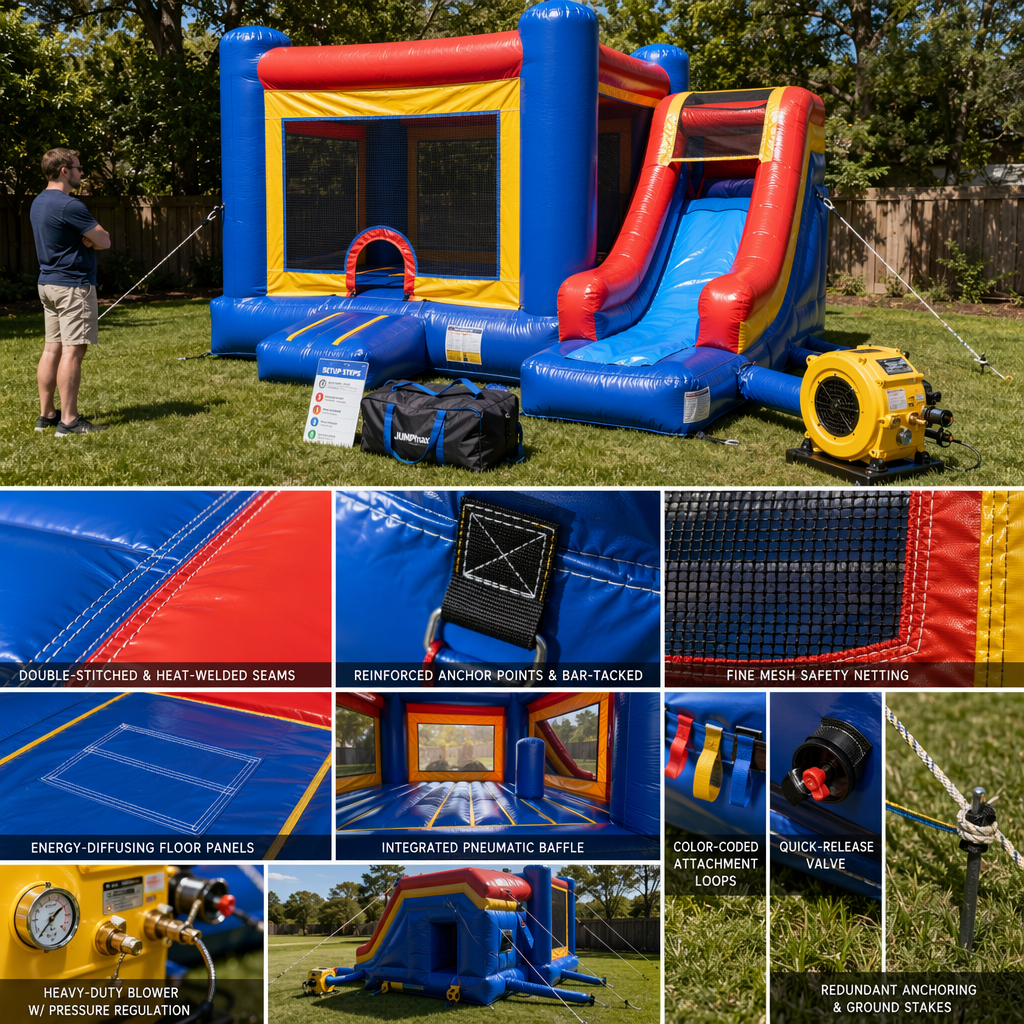
The design philosophy behind a suburban play centerpiece centers on robust materials and pragmatic safety features that withstand repeated exuberance. Constructed from heavy-duty, commercial-grade PVC and vinyl laminate, this inflatable resists abrasion, UV degradation, and seam delamination, ensuring long-term resilience even under intensive use. Reinforced seams are double- or triple-stitched and often heat-welded at stress points to prevent blowouts and extend service life.
Safety netting around the jump area preserves visibility while containing activity; its fine mesh reduces finger entrapment and allows rapid adult supervision. A secure inflation system — comprising a high-efficiency blower, pressure-regulation valves, and redundant anchoring points — maintains a stable bounce profile and prevents sudden deflation. Integrated splash guards and pneumatic baffles channel impact forces away from junctions, reducing strain on fabric and seams.
Practicality is enhanced by user-friendly setup and takedown: color-coded attachment loops, quick-release valves, and a compact storage bag allow fast deployment and hygienic packing. Routine maintenance is straightforward — surface cleaning, seam inspections, and patching small abrasions preserve integrity.
For backyard parties and recreational events seeking dependable, energetic play, the enduring choice lies in sturdy construction and meticulous reinforcement; the single most important attribute is durability.
PVC Reinforced Seam Durability: Welding, Double-Stitching, and Patch Strategies to Prevent Leaks and Extend Lifespan
Robust construction is paramount for a backyard inflatable that combines a slide and jump area, and premium PVC delivers resilience against abrasion, UV exposure, and repeated inflation cycles. Reinforced seams employ welding techniques alongside double-stitching to create a hermetic union that resists seam separation under dynamic loads. Strategic patch panels and sacrificial overlays can be installed at high-stress junctions to temper wear and prolong operational life. A redundant inflation system with baffled chambers reduces the risk of sudden deflation while maintaining even air distribution across the slide and bouncing platform. Safety netting incorporates high-tenacity mesh with reinforced anchor points to prevent entanglement and contain energetic play. Routine maintenance protocols—pressure checks, seam inspections, and seam-sealant touch-ups—mitigate micro-perforations before they propagate. These measures, fused with durable materials and meticulous craftsmanship, ensure long-term functionality and dependable safety for hours of active play in domestic recreational settings.
PVC
Integrated Slide and Jump Area Design: Load Distribution, Impact Zones, and Reinforced Flooring for Energetic Play
Constructed from industrial-grade PVC, this bounce house balances resilience and pliancy to withstand vigorous use while maintaining a safe surface. Reinforced seams and bar-tacked junctions reduce stress at high-tension points, prolonging service life. The integrated slide and jump area employ strategic load distribution, channeling impact through reinforced flooring and energy-diffusing panels to minimize rebound trauma. Safety netting encloses impact zones, preserving visibility and ventilation while preventing accidental egress. A secure inflation system maintains pressure stability, and rapid-deflate capability simplifies storage and transport. Altogether, robust materials and engineered reinforcement ensure dependable, energetic play for numerous backyard gatherings. Bounce house
Safety Netting Placement and Visibility: Preventing Falls, Maintaining Airflow, and Meeting Backyard Slide Safety Netting Standards
Constructed from robust, marine-grade PVC, this inflatable play structure fuses a slide and spacious jump area to deliver vigorous, sustained activity for children while resisting abrasion and UV degradation. Reinforced seams are double-stitched and thermally welded to prevent seam creep and air leakage, and an engineered inflation system maintains consistent pressure without cyclical sagging. Thoughtful placement of safety netting around the slide and perimeter preserves sightlines for supervision, prevents accidental egress, and promotes continuous airflow to reduce heat buildup. Netting mesh density balances fall-prevention with visibility, meeting contemporary backyard safety paradigms and allowing caretakers to monitor play from varied angles. Quick-attach anchors, rapid-deflate valves, and compact foldability simplify setup and storage, prolonging service life through minimised stress on stress points. The result is a durable, safety-oriented inflatable that supports exuberant play while adhering to pragmatic durability and ventilation standards for family gatherings and recreational events.
Easy Setup Inflatable Bounce House With Reinforced Seams And Secure Inflation System: Step-by-Step Assembly, Maintenance, And Deflation For Storage
Step-by-Step Assembly Guide: Secure Inflation Safety Guidelines, Anchoring, and Initial Inspection Before First Use
Begin by selecting a level, debris-free surface and unroll the bounce house with the slide and jump area fully extended. Check the material for punctures and test zippers and Velcro closures as part of an initial inspection. Connect the blower to the inflation port and ensure the secure inflation system valve is closed before powering on; watch the structure assume its shape and listen for steady airflow without whistling or sputtering. Anchor the unit using the supplied stakes or sandbags at all designated tie-down points; tension evenly to prevent tilting during exuberant play. Attach safety netting panels around the jump area and verify that seams around entrances and the slide exterior are reinforced and free of frays.
Maintenance requires routine surface cleaning with mild detergent, drying thoroughly to avoid mildew, and periodic seam sealant application where stitching shows wear. Inspect the blower intake screen and electrical cord for damage and maintain manufacturer-recommended air pressure for optimal rigidity. To deflate, power down the blower, open the primary exhaust valve, and press out residual air by folding from the far end toward the outlet. Roll compactly and store in a cool, dry place away from UV exposure. Follow these pragmatic steps to ensure durable, safe, and energetic play for children at backyard parties and events.
Reinforced Seams: Pre-Use Checks, Minor Repairs, and When to Use a Reinforced Seam Repair Kit
Begin assembly on level ground, unroll the inflatable and inspect attachment points and the inflation tube before powering the blower. Check all reinforced seams for uniform stitching and absence of delamination; these seams are critical to structural integrity and prolonged use. Engage the secure inflation system and allow the unit to reach full tautness while monitoring pressure; novice operators should learn to read subtle bulging or sagging that indicates uneven inflation.
Routine pre-use checks include tactile seam inspection, listening for micro-leaks, and scanning safety netting for abrasions. Minor repairs—small punctures or seam frays—can be addressed with a reinforced seam repair kit that contains adhesive patches, seam tape, and a roller to ensure intimate contact. Use the kit when stitches begin to separate or when the welded seam shows peeling beyond superficial scuffs. Deflation is simple: remove the blower, open the relief valves, fold systematically, and store dry. Prioritize maintenance to ensure continued safe, energetic play for children.
Daily Operation and Supervision Protocols: Safe Capacity Limits, Netting Checks, and Handling Energetic Play
Assemble the unit on a level surface and unfold the bounce house, aligning the inflation port with the supplied blower; allow the durable PVC to expand fully while monitoring the secure inflation system for constant pressure. Reinforced seams and stress-stitching should be inspected before each use to ensure structural integrity, and the safety netting must be free of tears and properly anchored to prevent entrapment. Supervise capacity limits rigorously: establish weight and occupancy thresholds, stagger entry to avoid collisions, and enforce footwear and sharp-object prohibitions. During operation, intermittently check air pressure and seam tension, and rotate active play to mitigate hotspot fatigue in any single area. For deflation, power down the blower, open valves to expedite air release, and fold methodically to prevent creasing that can weaken PVC over time. Store in a dry, ventilated container away from abrasive elements. This regimen prolongs longevity and sustains hours of energetic, secure recreational use.
Deflation and Storage Procedure: Proper Drying, Rolling Techniques, and Long-Term Care to Preserve Durable PVC Construction
Preparing the bounce house for storage begins with a thorough cleaning and complete drying to prevent mildew and degradation of the PVC. Remove debris, wipe surfaces with a mild detergent, and allow ample air circulation until seams and chambers are bone-dry. Partially deflate using the secure inflation system, then fold and roll methodically from the far end toward the valve to expel trapped air. Reinforce creases with gentle smoothing to avoid stress concentrators on the reinforced seams. Store in a breathable bag away from UV exposure and pest-prone areas. Routine inspections and occasional PVC conditioner application prolong resilience and operational longevity.
The most important keyword: Inflatable Bounce House With Slide And Jump Area
Safety Features And Supervision Best Practices For Safe Energetic Play In Jump Areas And Slides
Establishing Supervised Active Play Protocols: Roles, Ratios, and Communication for Safe Bounce House Use
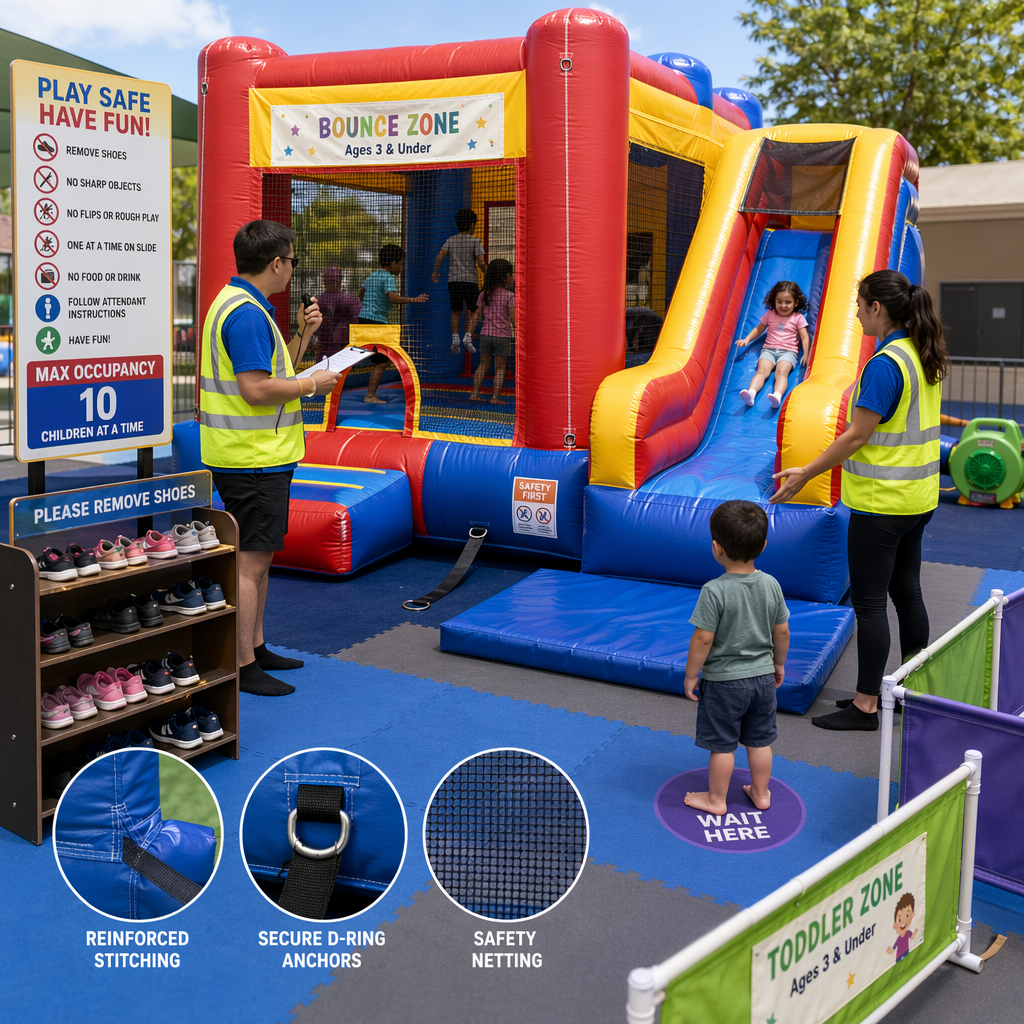
Assign clear supervisory roles before children enter the inflatable. Designate an attendant to monitor ingress and egress, another for slide traffic, and a floater to observe overall behavior. Maintain a practical ratio, commonly one adult per five to eight young children, adjusting for age and activity intensity. Use concise hand signals and a bell or whistle for immediate communication. Enforce staggered entry and controlled slide queues to prevent collisions. Inspect the unit for intact seams, secure inflation, and taut safety netting before each session. Rotate shifts to avoid fatigue and document incidents to refine protocols over time.
Slide Impact Protection Standards: Padding, Landing Zones, and Placement to Reduce Injury Risk
Ensure vigilant adult supervision and adherence to designated traffic flow to minimize collisions. Incorporate impact-absorbing padding, extended landing zones, and lateral barricades to mitigate deceleration trauma. Regularly inspect reinforced seams, inflation integrity, and netting tension. Teach staggered use, weight limits, and no-flip protocols to sustain a safe energetic environment.
Childrens Fall Prevention Measures Around Jump Areas: Footwear, Age Separation, and Entry/Exit Controls
Effective supervision and engineered safeguards together reduce risk during energetic play in bounce areas and slides. Enforce removal of shoes and accessories to prevent traction loss and punctures; encourage socks with grip for comfort and skid reduction. Implement age separation zones so littler children avoid collision with larger jumpers, and maintain a strict maximum occupancy limit to prevent overcrowding and inadvertent impacts. Control entries and exits with an attendant who times rotations and monitors sliding etiquette, ensuring one rider at a time and feet-first descents. Keep a clear perimeter free of obstacles and use soft landing mats at exit points to mitigate fall forces. Regularly inspect inflation pressure, seams, and anchoring to ensure structural integrity and avoid sudden deflation incidents. Train supervisors in basic first aid and child behavior management so they can de-escalate rough play swiftly. The most important keyword is fall prevention.
Vigilance, consistent rules, and engineered protections create a resilient play environment.
Regular Inspection and Maintenance Routines for Durable PVC Construction, Reinforced Seams, and Secure Inflation Systems
Routine scrutiny of an inflatable unit is essential to ensure longevity and safe operation; inspect the reinforced seams for any de-lamination, abrasion or stitch failure and probe PVC panels for pinholes, crazing, or UV embrittlement. Conduct a tactile perimeter check around anchor points and D-rings before each session, and verify the secure inflation system holds steady pressure without undue motor cycling. Establish a maintenance cadence: quick daily scans, weekly valve and blower exams, and a quarterly deep-clean with nonabrasive detergents and mildew inhibitors.
Supervision protocols should be codified and communicated to all caregivers: designate a responsible adult supervisor, maintain a visible line-of-sight, and enforce capacity limits to prevent overloading. Use rotational timeout intervals to reduce hyperthermia and fatigue; encourage age-homogeneous groupings to minimize collision risks.
During operation, ensure safety netting remains taut and undamaged; nets serve as the primary containment barrier and must be free of frays or large apertures. Keep the landing area clear and level, and never operate in high winds or heavy precipitation. Document inspections and any remedial actions in a logbook to create a continuity trail for preventive care and liability mitigation. These measures extend service life while fostering vigorous yet controlled play.
American Academy of Pediatrics Committee on Injury and Poison Prevention, Guidelines emphasize active adult supervision, age and size separation, equipment maintenance, and adherence to manufacturer capacity and installation instructions to reduce injury risk in inflatable play structures
Portability, Cleaning, And Storage Considerations For A Portable Deflatable Bounce House With Slide And Storage-Friendly Design
Folding and Transport Techniques for a Compact Foldable Bounce House Storage: Tips for Bagging, Strapping, and Vehicle-Friendly Packing
Portability is a prime consideration for any inflatable designed for backyard merriment. Begin by fully deflating the unit using the secure inflation system valve, then smooth out air pockets to create an even, compact profile. Fold methodically: collapse the slide section inward, roll from the far end toward the deflation port, and perform concertina folds on the jump area to minimize bulk. Use a durable carrying bag and apply wide, non-abrasive straps to prevent seam stress during transit. A small tarp beneath the deflated unit protects PVC from road grit when loading into a vehicle.
Cleaning extends lifespan; remove debris with a soft broom, then treat the PVC with mild, pH-neutral detergent and warm water. Rinse thoroughly and allow complete air-dry to avert mildew in seams and internal baffles. Pay special attention to the safety netting junctions and reinforced seams—spot-treat stains and inspect for microtears.
For storage, choose a cool, desiccated area away from UV exposure and rodents. Pack silica gel or breathable moisture absorbers with the deflated unit for humidity control. Label the bag and include a compact repair kit and the inflation blower hose for rapid redeployment. These pragmatic steps ensure the inflatable remains safe, resilient, and ready for exuberant play. Inflatable bounce house
Cleaning Protocols for Easy-Clean Deflatable Bounce House Materials: Surface Wipes, Deep-Clean Solutions, Mold Prevention, and Drying Best Practices
Routine wipes and a mild enzymatic solution preserve PVC sheen; tackle crevices with a soft-bristled brush. After deep-cleaning, ventilate fully to avert biofilm and mold formation.
Deflate, fold using accordion techniques, and store in a breathable bag away from UV and pests. Prioritize the inflation system during inspections.
Inflation System Care and Reinforced Seams Inspection Routine to Maintain Air-Tight Performance and Prolong Lifespan
When choosing a portable inflatable play unit, consider how easily it condenses for transport and its resistance to environmental soiling. Lightweight models with a compact fold pattern and integrated carry straps simplify transit, while a wipeable, chemically resistant PVC surface reduces labor during decontamination. Rinse gently after use, spot-treat stains with a mild, pH-neutral cleaner, and allow full aeration before stowing to prevent mildew.
Regular attention to the inflation system maximizes reliability: inspect blowers for lint buildup, ensure power cords and plugs remain intact, and verify the pressure relief valves operate smoothly. Lubricate zipper sliders sparingly with a silicone-based agent and avoid petroleum products that degrade PVC. Perform a seam inspection routine at least monthly during heavy use; probe reinforced seams for delamination, loose stitching, or micro-perforations and mark any anomalies for repair. Small punctures are often repairable with patch kits, while compromised seams may require professional re-welding.
Storage best practices include folding along original crease lines, placing acid-free sheeting between layers, and storing in a ventilated, temperature-stable environment away from UV exposure and rodents. Periodic reinflation tests simulate operational stress and reveal slow leaks early, preserving air-tight performance and prolonging the apparatus lifespan for many seasons of energetic play.
Seasonal Storage Planning and Climate-Controlled Options to Protect PVC Construction, Prevent UV and Moisture Damage
Proper portability, cleaning, and storage planning for a portable deflatable bounce house with slide hinges on understanding materials, dimensions, and routine maintenance. When deflating, fold methodically to avoid creases that can metamorphose into weak points; roll tightly and secure with straps to minimize volume and make transport effortless. Consider a wheeled duffel or rigid storage box sized for the packed unit to ease lifting and reduce abrasion during handling.
Cleaning should be proactive: remove grit and debris with a soft brush, then apply a mild, pH-neutral detergent diluted in water to the PVC surface. Rinse thoroughly and allow full air-drying in a ventilated, shaded area to preclude microbial growth in seams and behind netting. For stubborn stains use a non-abrasive pad—avoid solvents that can strip factory coatings. Pay special attention to safety netting and reinforced seams; inspect stitching and welds for separation and treat small punctures with approved patch kits following manufacturer specifications.
Seasonal storage planning benefits from climate-controlled solutions to forestall UV degradation and moisture-induced delamination. Opt for a cool, dry environment away from direct sunlight and heat sources; stable temperatures reduce polymer fatigue and prolong elasticity. Use silica gel packets or a breathable moisture barrier to control humidity and prevent mildew. For long-term layaway, inflate seasonally to redistribute stress and spot-check valves and inflation systems for leaks. Label the packed unit with inflation instructions and repair records to maintain provenance. With disciplined folding, meticulous cleansing, and considered climate control, the bounce house retains structural integrity and delivers safe, energetic play for years.
For further reading on material longevity and polymer degradation relevant to PVC inflatables, consult the Wikipedia entry on Polymer degradation and stabilisation which discusses mechanisms like photodegradation and hydrolysis that inform best practices for UV avoidance and moisture control https://en.wikipedia.org/wiki/Polymer_degradation_and_stabilisation
Wrapping Up
This article outlines how heavy-duty, commercial-grade PVC and reinforced vinyl construction deliver durability for an inflatable bounce house with slide and jump area, emphasizing tear resistance, UV protection, and robust seam techniques like welding and double-stitching. Reinforced flooring, energy-diffusing panels, and strategic load distribution protect impact zones while safety netting preserves visibility, airflow, and containment. A secure inflation system with redundant anchors and baffled chambers ensures pressure stability and reduces sudden deflation risks. Practical assembly, pre-use inspections, and routine maintenance—cleaning, seam checks, patching, and blower care—are detailed to extend lifespan. Supervision protocols, capacity limits, age separation, and slide landing protections minimize injury risks. Portability and storage recommendations cover methodical deflation, complete drying, compact rolling, breathable storage, and climate-controlled options to prevent UV and moisture damage. Regular inspection schedules, repair kit guidance, and documented maintenance routines are presented as essential measures to keep the inflatable safe, resilient, and ready for many backyard gatherings.