
Reading Time: 19 minute(s)
Step into a playful world where giant inflatable spheres transform calm lakes and backyard pools into rolling playgrounds. A zorb, commonly called an inflatable water ball, lets a person climb inside a transparent, cushioned orb and walk, run, or tumble across the water surface while remaining dry and buoyant. Designed with durable PVC material, secure sealed zippers, and safety air cushions, these spheres blend engineering and recreation to deliver a unique sensation of floating and motion. Perfect for summer events, family outings, or amusement attractions, the zorb experience combines gentle exercise with the thrill of controlled rolling. This guide explores how the water ball works, safety considerations, setup tips, and recommended uses so readers can enjoy this novel activity with confidence and fun.
Content Outline
- How a Transparent Water Walking Sphere Works: Design, Materials, and Mechanics
- Clear PVC Water-Walking Ball Construction: layers, seam welding techniques, and transparent polymer choices that ensure visibility and durability
- Buoyancy mechanisms and stability control: how air volume, flotation dynamics, and weight distribution let a person roll safely across water
- Airtight seal and valve systems: inflation protocols, double-valve designs, and leak-prevention testing for reliable performance
- Flexible polymer stress resistance and fatigue management: material fatigue, UV resistance, and maintenance practices to prolong the sphere’s life
- how to use giant water zorbing ball safety tips and setup
- Essential setup checklist for a giant inflatable ball: site assessment, inflation technique, and anchoring
- Pre-ride inspection and routine zorb ball maintenance and inspection to prevent failures
- Operational safety guidelines and giant water zorb safety guidelines for riders and supervisors
- Emergency procedures, hazard prevention on open water, and communication protocols
- Best Practices for Supervision, Age Limits, and Emergency Procedures
- Clear Child Supervision Guidelines: Roles, Ratios, and Active Monitoring Techniques for Water Zorb Use
- Establishing Age-Appropriate Activity Limits and Physical Readiness Checks Before Letting Participants Climb Inside
- Emergency Response Protocols: Rescue Procedures, Communication Plans, and On-Site First Aid Essentials
- Safety Training for Supervisors: Practical Drills, Risk Assessment, and Certification Recommendations
- Activities, Event Ideas and Maintenance for Your Inflatable Human Hamster Ball on Lake
- Safety protocols and water zorbing safety tips: pre-ride checks, emergency procedures, and recommended personal gear for lake use
- Lake-friendly team building games and event formats using a giant inflatable water ball: timed relays, cooperative challenges, and spectator-friendly tournament structures
- Inflatable ball maintenance checklist for longevity: cleaning, storage, valve inspections, and patching procedures after lake use
- Logistics and permitting: outdoor event permitting requirements, site selection, water depth considerations, and liability planning
- Bottom Line
How a Transparent Water Walking Sphere Works: Design, Materials, and Mechanics
Clear PVC Water-Walking Ball Construction: layers, seam welding techniques, and transparent polymer choices that ensure visibility and durability
Transparent water-walking spheres rely on a multi-layered architecture designed for buoyancy, clarity, and user safety. The exterior often uses crystal-clear PVC or thermoplastic polyurethane laminates that resist UV degradation and scuffing, while inner plies incorporate reinforced warp-knit fabric to distribute loads and prevent catastrophic failure. Seams are typically joined by high-frequency welding or radio-frequency fusion to create hermetic bonds without stitching perforations; heat-sealed vulcanization is another method that produces durable, monolithic seams. Attention to edge geometry and weld overlap mitigates stress concentration during rolling and ingress.
A transparent polymer selection balances optical transparency with tensile strength; softer elastomers provide suppleness for folding and storage, whereas higher Shore hardness grades enhance puncture resistance. Airlocks, double-zip entry systems, and gasketed closures preserve internal pressure and permit safe entry and egress. Internal pressure is maintained within a narrow psi band to retain spherical rigidity while allowing slight compliance to dampen impacts.
Mechanically, the sphere translates human locomotion into rotational kinetic energy across the water surface, with low friction between polymer and water enabling smooth traversal. Regular inspection of weld beads and polymer sheen is crucial to identify microfissures before they propagate. The primary keyword for this section is transparent water-walking sphere.
Buoyancy mechanisms and stability control: how air volume, flotation dynamics, and weight distribution let a person roll safely across water
The transparent water walking sphere relies on precise displacement and sealed-air retention to support a human mass. A large internal air cavity creates buoyancy by displacing water, while the shell’s tensile strength and seam integrity prevent leaks. Stability is achieved through low center of gravity and weight distribution; users crouch or strap to central zones to avoid capsizing. Inflatable chambers with baffling reduce sloshing and damp oscillations, enhancing roll control. Surface traction comes from textured interiors, and rotational momentum is moderated by controlled venting and operator technique. Key to safe operation is proper inflation pressure and material resilience against puncture.
buoyancy
Airtight seal and valve systems: inflation protocols, double-valve designs, and leak-prevention testing for reliable performance
The transparent water walking sphere relies on robust engineering: layered thermoplastic polyurethane skins laminated for puncture resilience and UV stabilization. Internal baffles maintain spheroidal geometry while displacing air evenly as the occupant moves. A critical element is the airtight seal system, often employing a dual-valve protocol—an inner self-sealing inflation valve plus an exterior locking cap—to permit rapid inflation and redundant protection against pressure loss. Inflation follows calibrated psi targets monitored with a gauge. Leak-prevention testing includes vacuum chamber inspection, soapy-film surface checks, and cyclic pressure trials to detect micro-perforations before recreational deployment.
Maintenance routines preserve seals and extend service life.
Flexible polymer stress resistance and fatigue management: material fatigue, UV resistance, and maintenance practices to prolong the sphere’s life
Transparent water walking spheres are engineered as pressurized membranous chambers that combine buoyancy, flexibility, and resilience. The outer envelope is typically a multilayer thermoplastic elastomer or PVC composite formulated for high tensile strength and low creep; these polymers distribute loads across the shell when a person moves inside and when the sphere deforms during rolling. Seams are welded or glued using solvent-free techniques to avoid stress concentrators that precipitate tears.
Material fatigue is managed through design redundancies: thicker panels at high-strain zones, reinforcement tapes along seams, and deliberately placed gussets to mitigate cyclic bending. UV stabilizers and hindered amine light stabilizers are compounded into the polymer to retard photodegradation and maintain elongation at break over seasons. Routine maintenance prolongs service life; this includes controlled inflation pressure monitoring, surface inspections for microabrasions, and careful deflation protocols to prevent pinhole propagation. Avoiding prolonged contact with hydrocarbons and abrasive substrates reduces chemical and mechanical attack.
When damage occurs, patch repairs use compatible polymeric patches and heat or chemically activated adhesives to restore a homogenous stress field. The most critical parameter for longevity is material fatigue, because repeated dynamic loading governs the sphere’s operational lifespan.
According to a 2020 technical brief from the American Society for Testing and Materials (ASTM), successful design of inflatable recreational watercraft and similar pressurized polymer structures depends on multi-layer laminate construction, hermetic RF- or high‑frequency welded seams, redundant valve systems, and routine cyclic pressure testing to detect micro-leaks—measures that directly inform material selection, seam geometry, and maintenance protocols for transparent water-walking spheres.
how to use giant water zorbing ball safety tips and setup
Essential setup checklist for a giant inflatable ball: site assessment, inflation technique, and anchoring
Assess the site for depth, currents, and underwater hazards before deploying the orb. Use a calibrated pump and follow precise inflation technique to avoid seam stress. Anchor with quick-release lines and establish a safety perimeter. Supervise riders, enforce floatation use, and perform periodic pressure checks to maintain stability and prevent incidents.
Pre-ride inspection and routine zorb ball maintenance and inspection to prevent failures
Before inflating a giant water zorbing ball, conduct a meticulous pre-ride inspection to mitigate risk. Examine the outer membrane for microabrasions, delamination or seam creep; use tactile and visual checks in bright light. Verify inflation valves, ensuring they seat correctly and exhibit no thread wear. Confirm the integrity of internal tether points and harnesses if present; pull gently on attachments to detect hidden fatigue. Check for embedded foreign objects on the launch surface, such as glass, shell fragments or jagged stones, and clear a radius that exceeds the ball diameter. Inspect the air pressure after inflation with a calibrated gauge rather than relying on feel—both under and over inflation can precipitate punctures or structural distortion.
Routine maintenance prolongs service life and prevents sudden failures. Rinse freshwater after saline exposure and employ pH-neutral cleaners to avoid polymer breakdown. Store the apparatus in a climate-controlled, UV-shielded environment to prevent photodegradation and plasticizer migration. Rotate inspection logs after every session; document pressure readings, repair patches applied, and any anomalous noises during use. Replace one-way valves and repair patches using manufacturer-approved vulcanizing agents or high-bond adhesives; avoid improvised materials that can outgas or become brittle. Periodically perform hydrostatic soak tests in a controlled setting to reveal slow leaks and seam weaknesses. Train attendants in emergency extraction protocols and establish a buddy system for solo riders. Final pre-ride checklist should include weather evaluation, swimmer readiness, and proximity to safe egress points. Prioritizing these preventive measures reduces mechanical failure probability and enhances participant safety during dynamic water zorbing activities. The most important keyword in this section is pre-ride inspection.
Operational safety guidelines and giant water zorb safety guidelines for riders and supervisors
Prioritize pre-use inspection and environmental appraisal before entering a giant water zorb. Check seams, valves and tether points for abrasion or microperforations, and confirm buoyancy aids are available on the landing zone. Riders should wear minimal metallic objects and secure loose garments; long hair must be tied to avoid entanglement. Supervisors must establish a clear perimeter and maintain continuous visual contact, with a designated spotter armed with an emergency knife and flotation device. Limit session durations to avoid hypoxia; implement staggered rotations and allow recovery intervals. Launch only in calm, shallow water away from motors, submerged hazards and strong currents. Use reliable inflation pressure — overinflation stresses PVC or TPU laminates, underinflation compromises maneuverability. Enforce a strict single-user policy unless the zorb is rated otherwise, and institute a verbal pre-ride checklist including signal for immediate extraction. Train staff in rapid water rescue techniques and cardiopulmonary resuscitation to mitigate rare but serious incidents. water zorb
Emergency procedures, hazard prevention on open water, and communication protocols
Before entering the orb, brief companions on rendezvous points and establish a simple hand-signal lexicon to summon aid. Equip a flotation vest and a tethered rescue buoy stationed on the shore; a wearable whistle is indispensable. Monitor local weather synoptics and avoid gust-prone windows when launching. If the ball capsizes or the occupant becomes disoriented, remain calm, activate the whistle, and one shore attendant should maintain line-of-sight while another retrieves the tether. For open-water excursions, maintain a safety perimeter with a support kayak or motor craft at a discreet distance to prevent prop wash and to offer rapid extraction. Avoid crowded waterways and maintain at least a two-person lookout system. Inspect seams and zippers for abraded material before each use, and ventilate the interior periodically to prevent hypoventilation. The primary hazard to mitigate is entrapment, so rehearse extrication maneuvers and communication protocols until they become reflexive; this reduces panic and accelerates rescue response times.
Best Practices for Supervision, Age Limits, and Emergency Procedures
Clear Child Supervision Guidelines: Roles, Ratios, and Active Monitoring Techniques for Water Zorb Use
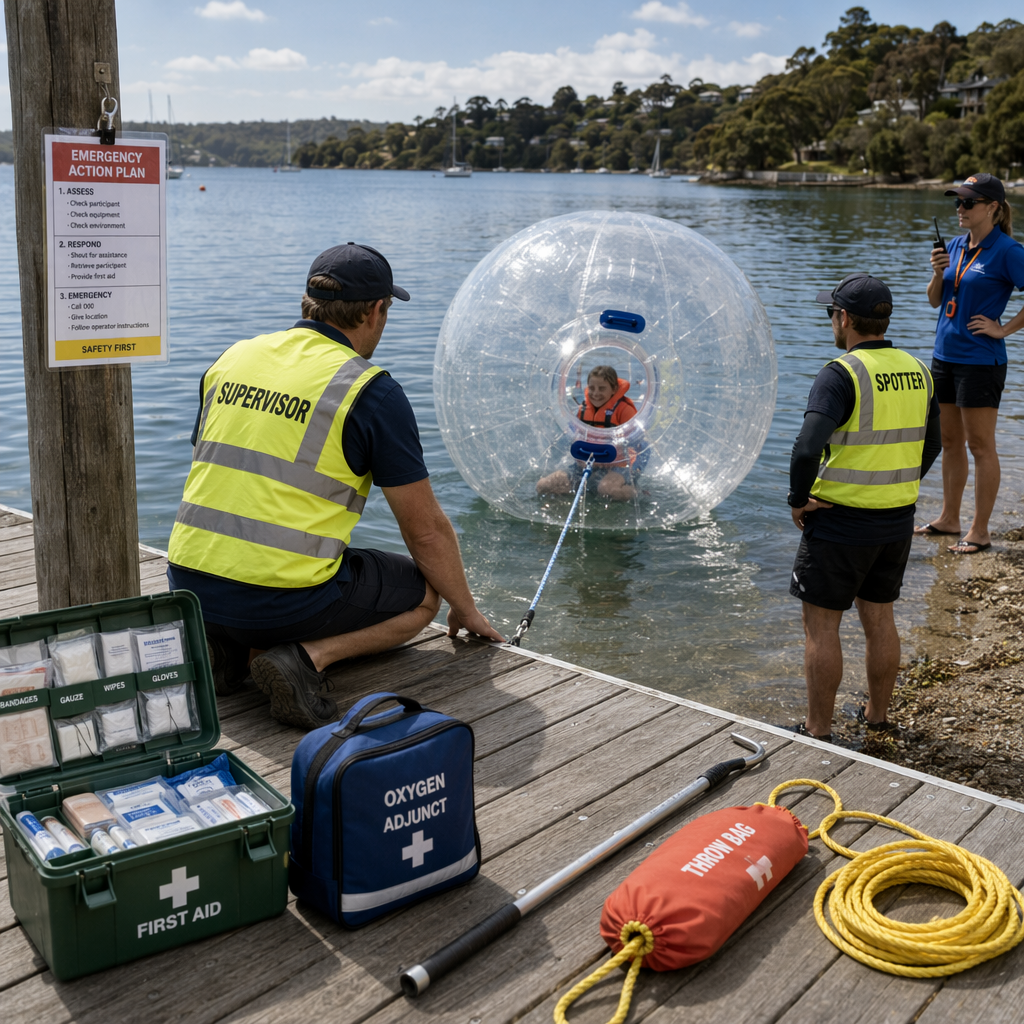
Establish explicit supervision roles before any water zorb session: designate a primary guardian, a secondary observer, and a spotter onshore to manage ingress and egress. For child use, adhere to conservative ratios such as one adult per two small children, adjusting for age, swimming proficiency, and ambient conditions. Active monitoring techniques include continuous line-of-sight observation, rotational shifts to prevent fatigue, and use of a whistle or hand signals for rapid intervention. Define age limits using developmental markers rather than arbitrary numbers: ensure children have sufficient body awareness, buoyancy tolerance, and ability to follow emergency commands. Prearrange emergency procedures that cover extraction, hypothermia protocol, and airway management; rehearse these with staff or guardians so responses become proceduralized. Keep rescue equipment staged nearby, including a reach pole, flotation cushion, and communication device. Regularly reassess risk factors like wind, glare, and water traffic to decide when to suspend activities for safety. supervision
Establishing Age-Appropriate Activity Limits and Physical Readiness Checks Before Letting Participants Climb Inside
Supervision should balance vigilance with enabling fun; assign a designated attendant trained in rescue techniques and basic first aid. For safety, set clear age thresholds based on size and coordination rather than arbitrary numbers, and conduct a quick physical readiness appraisal—assess balance, breath control, and any cardiovascular or musculoskeletal contraindications. Use staggered entry times to prevent congestion and ensure visibility across glare-prone water. Establish an emergency protocol with signalling methods, flotation aids nearby, and immediate extraction procedures. Regularly rehearse rescues and review incident logs to refine response times and maintain a culture of anticipatory safety. supervision
Emergency Response Protocols: Rescue Procedures, Communication Plans, and On-Site First Aid Essentials
Supervisors must enforce age-appropriate limits and constant visual contact, with spotters and flotation backups staged. Establish a concise rescue protocol: buoyant retrieval gear, tethered retrieval lines, and a designated communicator using whistles or radios. Maintain an on-site first aid kit, oxygen adjunct, and trained responders ready for rapid extrication and hypothermia mitigation.
Safety Training for Supervisors: Practical Drills, Risk Assessment, and Certification Recommendations
Supervisors must undertake structured instruction that blends classroom theory with hands-on immersion exercises. Practical drills should include timed extrication, tethered rescue simulations, and victim retrieval from within a rolling orb to build muscle memory. Incorporate scenario-based risk assessments that catalogue environmental variables such as wind vector, water current, temperature gradients, and proximity to hard substrates. Adopt a concise incident action plan template so supervisors can rapidly triage situations and delegate tasks.
Certification recommendations: prioritize accredited lifesaving credentials, proficiency in small-boat handling, and training in confined-space extraction techniques adapted for inflatable spheres. Regular recertification intervals—ideally annually—ensure currency with emergent rescue protocols.
Age limits must align with physiological capability and cognitive judgment; supervisors should use competency-based screening rather than arbitrary age cutoffs, assessing balance, buoyancy tolerance, and ability to follow complex instructions. Maintain a strict supervisor-to-participant ratio and employ continuous visual and radio monitoring.
Emergency procedures require pre-positioned rescue equipment, ready-to-deploy recovery lines, and a communication cascade including local emergency services. Conduct periodic unannounced drills to test response times and identify latent vulnerabilities. The overarching priority is mitigation of hazards through anticipatory planning and rigorous supervision.
Activities, Event Ideas and Maintenance for Your Inflatable Human Hamster Ball on Lake
Safety protocols and water zorbing safety tips: pre-ride checks, emergency procedures, and recommended personal gear for lake use
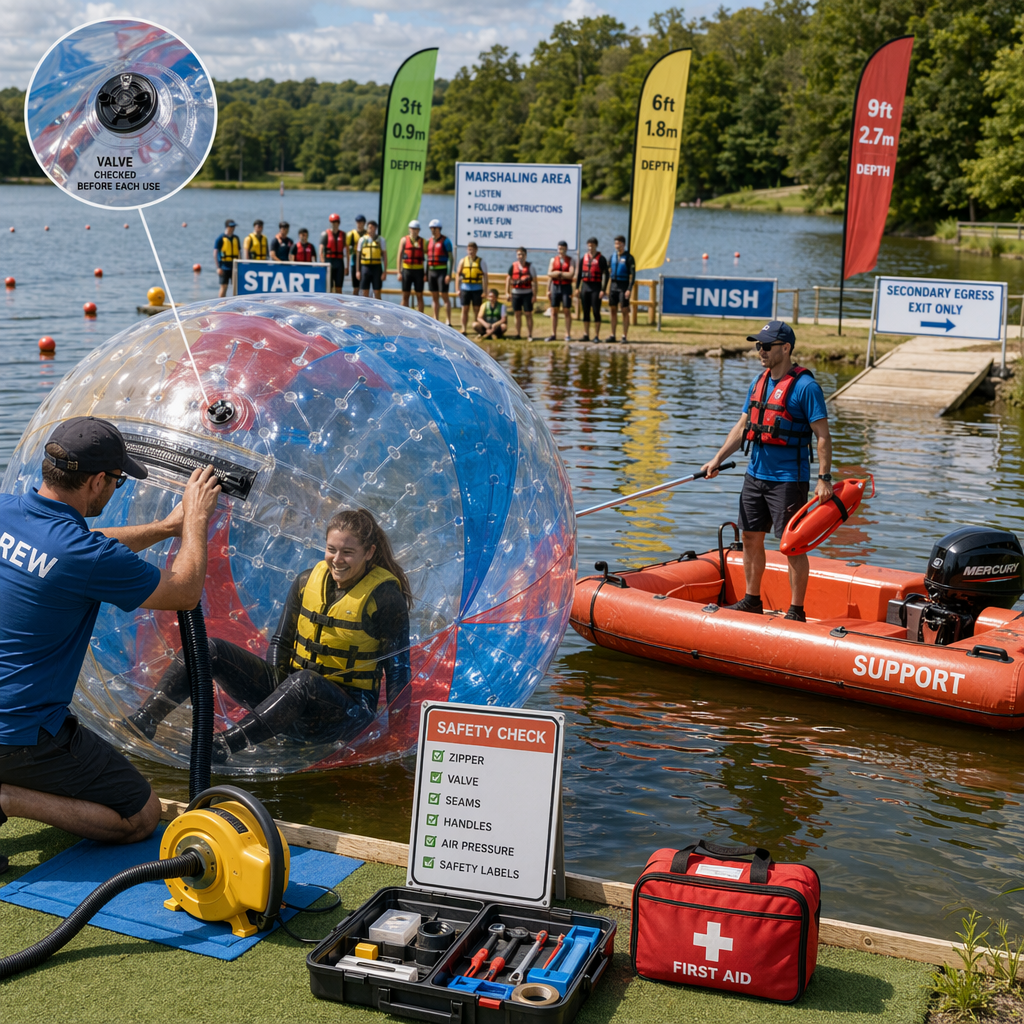
Operating a large inflatable human ball on a lake requires procedural rigor to ensure enjoyment without incident. Begin with systematic pre-ride checks: inspect the bladder for delamination, verify zipper integrity, and confirm air pressure within manufacturer tolerances. Evaluate environmental variables—wind vector, surface chop, and water temperature—before deployment. Brief riders on breathing cadence, motion control, and the importance of staying centered to maintain stability. Use a buddy system and assign a spotter in a safety craft equipped with a throwable flotation device and a reach pole. Establish clear emergency procedures: deploy the spotter craft immediately if the rider becomes disoriented, cut air supply if hyperventilation is suspected, and perform an expedited extraction using the reinforced harness points around the equator seam. For prolonged sessions, limit continuous ride time to prevent CO2 buildup and hypercapnia; rotate riders regularly. Recommended personal gear for lake use includes a coastguard-approved life vest, neoprene thermal layer in cold conditions, water shoes with secure straps, and a waterproof whistle. Carry a basic first-aid kit and a thermal blanket in the support boat. Maintain meticulous logs of each session, noting anomalies and repairs. Regular maintenance and adherence to these protocols preserve safety and extend the operational life of the inflatable human hamster ball.
Lake-friendly team building games and event formats using a giant inflatable water ball: timed relays, cooperative challenges, and spectator-friendly tournament structures
Design lake days around the inflatable human hamster ball with games that balance competition and camaraderie. Timed relays work well: participants sprint across marked buoys, tag a teammate, and reverse direction, promoting agility and coordination. Cooperative challenges such as paired navigation—two people in adjacent balls tethered loosely—require synchronized shifts in weight to traverse a course, encouraging nonverbal communication and trust. For spectator-friendly formats, structure a double-elimination tournament with short heats to keep energy high and audiences engaged; include novelty heats like costume rounds or obstacle negotiation to amplify pageantry. Event logistics should address safety and maintenance: rotate balls to allow airing and inspect seams between heats, rinse away algae, and check zipper integrity. Use a marshaling area for staging, clearly signaled start/finish lines, and a small shore crew trained in swift-water retrieval. These measures ensure smooth flow, reduce downtime, and preserve equipment longevity while maximizing participant enjoyment.
Inflatable ball maintenance checklist for longevity: cleaning, storage, valve inspections, and patching procedures after lake use
Plan buoyant activities like timed sprints, team relays, or slow-motion choreography to maximize fun while minimizing collisions. For events, establish a staging zone and rotation protocol so users enter and exit the sphere safely. After lake use, follow a rigorous maintenance checklist: rinse thoroughly with fresh water to remove biofilm and grit, then apply a mild sanitizing solution. Inspect all valves and seams for microfissures; torque and reseat valve caps as needed. Dry fully in shade to prevent polymer degradation. Keep a repair kit handy for punctures—use solvent-activated patches and allow full cure time before reinflation. The central priority is maintenance.
Logistics and permitting: outdoor event permitting requirements, site selection, water depth considerations, and liability planning
Planning activities with a large inflatable ball that lets a person climb inside and roll across water requires careful attention to logistics and safety. Start by assessing permitting: many municipalities treat aquatic events as regulated gatherings, so contact local parks departments or harbor masters early to obtain temporary use permits, public assembly approvals, and any environmental clearances. Site selection should prioritize unobstructed shoreline, convenient ingress and egress, and a shallow graded slope for easy launching. Identify a secondary egress zone for emergencies and ensure the staging area can accommodate inflation equipment, attendant stations, and spectator flow.
Water depth considerations are critical; the ideal depth balances buoyancy and collision risk — roughly a minimum of 1.2 to 2 meters reduces grounding while keeping the ball from becoming airborne in waves. Survey for submerged hazards, strong currents, and drop-offs. Use depth sounding and marked swim buoys to delineate the operating envelope.
Liability planning demands comprehensive risk mitigation: implement written waivers, age and weight restrictions, and mandatory briefings that cover entrapment avoidance, self-rescue techniques, and hand signals. Staff should include certified lifeguards and a dedicated rescue boat on standby. Insurance should list the event specifics and the activity as a high-risk aquatic attraction.
Operational protocols—regular pre-session inspections for seam integrity, inflation pressure logs, and scheduled rotation limits—will reduce wear and exposure liability. Communicate contingency plans for adverse weather and establish an incident reporting procedure. This layered approach ensures the experience is both exhilarating and administratively sound.
For further reading on aquatic event safety principles and hypoxia prevention protocols that can inform your emergency procedures and operational limits, consult this resource from a reputable educational institution: University of Kentucky Recreational Water Safety Guide. This guidance complements the operational lexicon above with empirical recommendations on water competency assessment, supervision ratios, and environmental risk appraisal useful for calibrating ride durations, staffing matrices, and post-incident documentation.
Bottom Line
Transparent water-walking spheres and giant water zorbs combine multilayer polymer construction, welded seams, and redundant valve systems to provide visibility, buoyancy, and safety. Key design elements include crystal-clear PVC or TPU laminates, reinforced warp-knit inner plies, hermetic RF or HF welds, and internal baffles to control sloshing and maintain spheroidal geometry. Proper inflation pressure, airtight seals, and routine leak testing are critical to prevent failures and manage material fatigue. Operational safety emphasizes thorough pre-ride inspection, site assessment for depth and hazards, anchoring, and supervision protocols with clear roles and rescue equipment. Age-appropriate readiness checks, staff training in extrication and CPR, and rehearsed emergency procedures reduce entrapment risks. Event planning calls for permits, liability mitigation, and maintenance practices such as freshwater rinsing, drying, and compatible patch repairs to extend service life. Following these engineering and procedural best practices ensures safe, durable, and enjoyable water-zorbing experiences.