
Reading Time: 17 minute(s)
Large helium inflatable advertising blimps offer an attention-grabbing solution for promotions, delivering brand visibility that towers above standard signage. Ideal for events, trade shows, store openings and outdoor marketing campaigns, these oversized blimps combine mobility with remarkable aerial presence to attract crowds from a distance. Customizable with logos, colors and messaging, branded blimps create memorable impressions and reinforce brand recognition across large venues. Durable materials and reliable helium inflation systems ensure steady performance during extended events, while tethering options and LED lighting enhance safety and nighttime visibility. Whether positioned over a festival, anchored outside a grand opening or floated above a trade show floor, a high-visibility inflatable blimp helps cut through advertising noise and drive foot traffic. This versatile promotional tool suits businesses seeking impactful, large-scale marketing that transforms ordinary spaces into brand-driven experiences.
Content Outline
- Designing Impactful Messaging and Graphics for a custom printable promotional helium blimp for trade shows and exhibitions
- Establishing Visual Hierarchy: Prioritizing Logos, Slogans, and Key Messages for Maximum Readability at Distance (trade show inflatable branding)
- Color, Contrast, and Typography Choices to Ensure Legibility and Brand Recognition on a Large Helium Inflatable Advertising Blimp
- Integrating Imagery and Iconography: How Scalable Graphics and Simplified Artworks Improve Impact for exhibition promotional design
- Placement and Size Planning: Mapping Design Around Panels, Seam Lines, and Viewing Angles for Events and Trade Shows
- Logistics, Helium Requirements, and Safe Anchoring for large helium inflatable advertising blimp for outdoor event promotions
- Calculating Helium Volume and Lift: Determining Fill Levels, Gas Requirements, and Safe Payload Capacity for a Large Helium Inflatable Advertising Blimp
- Weather-Safe Tethering Techniques and Secure Anchoring Methods: Stakes, Ballast, Dynamic Tethers, and Wind Thresholds for Outdoor Inflatable Event Anchoring
- Logistics for Promotional Blimp Deployment: Transport, On-site Assembly, Artwork Setup Considerations, and Timeline Coordination
- Event Applications: How branded blimps Enhance Visibility at Festivals, Product Launches, Store Openings and Indoor Venues
- Maximizing Crowd Engagement at Festivals and Fairs with Branded Aerial Advertising: Placement, Visual Hierarchy, and Interactive Integration
- Indoor Promotional Blimps for Conventions and Trade Shows: Navigating Ceiling Heights, Venue Regulations, and Anchor Strategies
- Store Openings and Product Launches: Using Large Helium Inflatable Advertising Blimps to Create Sightlines, Reinforce Brand Messaging, and Drive Foot Traffic
- Materials, Lighting Options and Durability Considerations for Long-duration Promotional Flights
- Choosing UV-Resistant Fabric and Coatings for Outdoor Longevity: material types that withstand sun exposure and prevent color fade
- Construction Materials and Seams: comparing reinforced Nylon, PVC, and TPU for puncture resistance and load-bearing anchors
- LED Lighting Solutions for Long-Duration Inflatables: battery, solar, and low-heat options to maintain visibility without compromising material integrity
- Anchoring Systems, Wind and Weather Durability, and Safe Flight Windows: best practices for mooring, gust tolerance, and operational limits
- Summary
Designing Impactful Messaging and Graphics for a custom printable promotional helium blimp for trade shows and exhibitions
Establishing Visual Hierarchy: Prioritizing Logos, Slogans, and Key Messages for Maximum Readability at Distance (trade show inflatable branding)
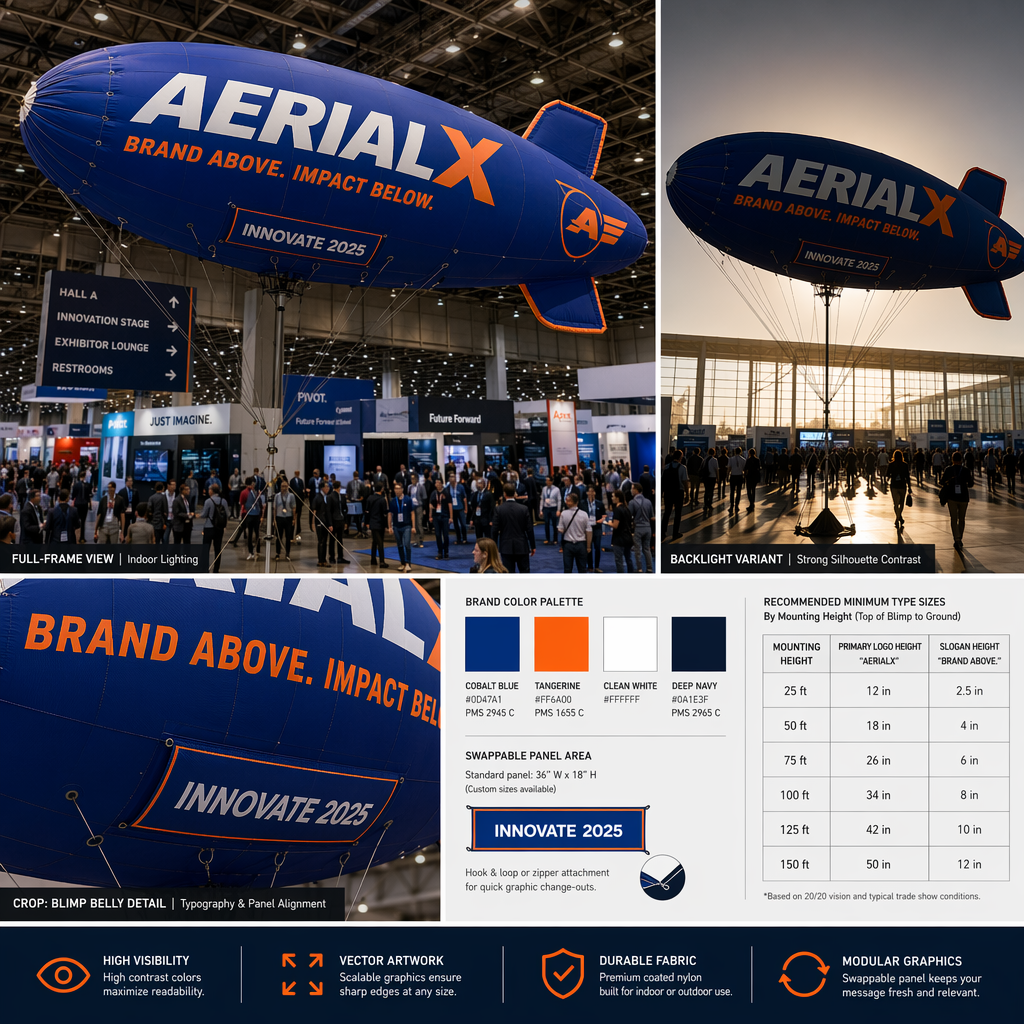
Creating a memorable aerial presence requires deliberate composition: prioritize a bold, legible logo at the blimp nose or center where curvature and viewing angle are optimal. Secondary elements such as a concise slogan or call line should use high-contrast typography and be limited to a few words to preserve legibility at distance. Employ scale hierarchy — oversized primary mark, medium taglines, and minimal ancillary icons — so viewers parse information within seconds while the blimp drifts above crowds. Consider negative space and wrap-adjusted artwork to accommodate seams and tether points; this prevents visual clutter and distortion. Palette selection matters: choose chromatic contrasts resilient to daylight washout and silhouette degradation. For trade shows and exhibitions, orient messaging along the longitudinal axis to maximize readable surface area when viewed from the ground. Test mockups at various vantage points and heights to validate prominence. Lastly, ensure printing files account for material stretch and finishing tolerances to maintain fidelity of the final airborne display.
Color, Contrast, and Typography Choices to Ensure Legibility and Brand Recognition on a Large Helium Inflatable Advertising Blimp
When crafting visuals for a large helium inflatable advertising blimp, prioritize high-contrast palettes and bold typographic hierarchies so messages remain decipherable from afar. Opt for saturated hues that retain chromatic fidelity outdoors and pair them with neutral backgrounds to prevent visual muddiness. Use condensed sans-serif or geometric display typefaces for main slogans, and reserve ornamental fonts for secondary elements only; kerning and stroke width must be tuned to counteract fabric stretch and viewing angle distortion. Consider pictograms and simplified logos to preserve semantic clarity at altitude, and place key information along the blimp belly where curvature minimally warps content. For maximum impact, test mockups under varied luminance conditions and from multiple vantage points. Balance striking aesthetics with pragmatic legibility to prolong viewer retention and brand recall. The principal design imperative is clear: ensure the message reads instantly while maintaining a distinctive, aeriform presence that dominates festival and exhibition skies.
Integrating Imagery and Iconography: How Scalable Graphics and Simplified Artworks Improve Impact for exhibition promotional design
For trade shows and exhibitions, crafting bold, legible visuals on a helium blimp ensures messages ascend above visual clutter. Start with a dominant, high-contrast motif and simplify iconography into emblematic forms that remain discernible at distance. Balance negative space and a succinct headline to prevent visual noise; complex gradients can blur when scaled. Consider vector artwork and spot colors for crisp reproduction on inflatable substrates. Durable inks and UV-resistant finishes preserve chromatic fidelity outdoors. Anchoring zones and orientation dictate where to place logos so they face viewer flows. The result is an elevated, memorable presence that amplifies brand recognition and wayfinding across a crowded venue. helium blimp
Placement and Size Planning: Mapping Design Around Panels, Seam Lines, and Viewing Angles for Events and Trade Shows
Effective design for a promotional helium blimp begins with pragmatic spatial reasoning: understand the curvature, panel segmentation, and seam topology so artwork remains coherent when the envelope is inflated. Consider the viewer’s vantage points at trade shows and exhibitions; elements placed along the dorsal plane will be most legible from afar, while port and starboard panels are optimal for lateral traffic flow. Map logos and copy across multiple panels to prevent distortion at seams, and allocate bleed margins to accommodate slight warping during inflation.
Use scale hierarchies—large emblematic marks for instant recognition and microcopy for proximal inspection—to balance spectacle with information. Contrast is critical in aerial signage: select high-chroma palettes and stark value contrasts so the motif reads clearly against varying ambient light. Apply vectorized artwork to preserve crisp edges when enlarged; raster elements can introduce moiré artifacts and pixelation on fabric substrates.
Factor in viewing distances. For ceiling-slung or high-mast deployments, upsize typography and simplify iconography; for low-hanging indoor placements, integrate finer details and directional cues. Orientation markers during production prevent upside-down branding and ensure oblique viewing maintains narrative flow.
Logistics also inform design: include anchoring points and tether lines in the visual plan so they do not occlude key messaging. Plan for interchangeable panels where event-specific slogans can be swapped without reprinting the entire envelope. Finally, prototype with scale maquettes or augmented-reality overlays to anticipate how lithography, seam lines, and volumetric distortion will affect perception in situ. The paramount keyword for this topic is visibility.
According to the Outdoor Advertising Association of America, clear visual hierarchy, high-contrast color choices, and simplified iconography are essential for large-format aerial and inflatable advertising to ensure legibility at distance and resilience under outdoor lighting conditions — recommending vector artwork, spot colors, and prototyping to account for material stretch and viewing-angle distortion.
Logistics, Helium Requirements, and Safe Anchoring for large helium inflatable advertising blimp for outdoor event promotions
Calculating Helium Volume and Lift: Determining Fill Levels, Gas Requirements, and Safe Payload Capacity for a Large Helium Inflatable Advertising Blimp
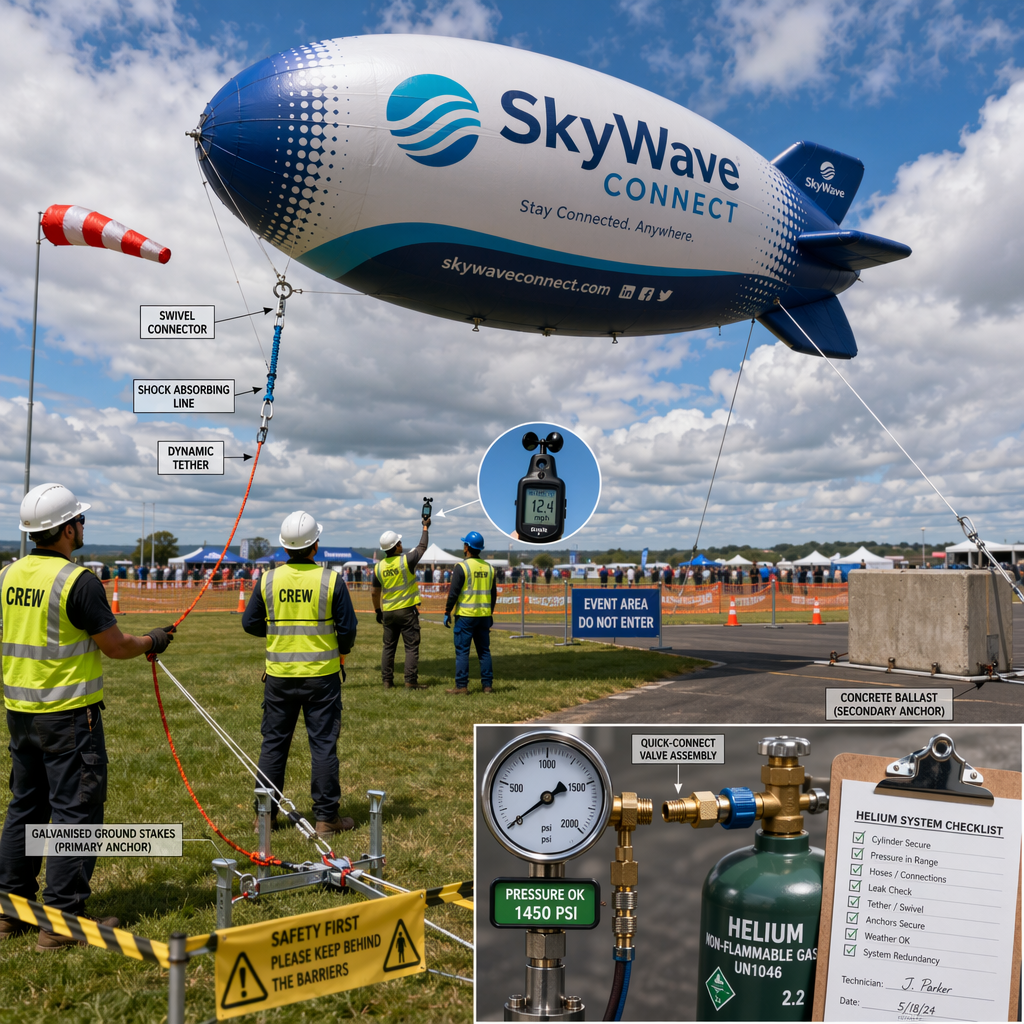
Planning a large helium inflatable advertising blimp demands precise logistics: calculate envelope volume, account for temperature and altitude, and specify fill to achieve neutral buoyancy while preserving structural integrity. Estimate helium needs by multiplying blimp volume by desired fill percentage, then add contingency for leaks and thermal expansion. Secure anchoring is essential—use dynamic tethering, shock-absorbing lines, and redundant anchor points to resist gust loads and vortex shedding. Consider payload capacity when adding lighting or banners; every kilogram alters lift and center of gravity. Thorough preflight checks, calibrated gauges, and a lift margin safeguard both performance and public safety.
helium
Weather-Safe Tethering Techniques and Secure Anchoring Methods: Stakes, Ballast, Dynamic Tethers, and Wind Thresholds for Outdoor Inflatable Event Anchoring
For outdoor promotions, meticulous planning around logistics ensures a large helium inflatable advertising blimp performs reliably and safely. Calculate helium volume and regas schedules based on ambient temperature and porosity to maintain lift throughout multi-day events. Transport considerations include compact packing, protective crating, and quick-connect valves for rapid inflation on site. Secure anchoring prevents drift and damage: employ galvanised stakes for soft ground, concrete ballast for paved areas, and hybrid mooring with dynamic tethers to absorb gust loads. Integrate swivel connectors and shock-absorbing lines to mitigate cyclical stress.
Wind thresholds are critical—establish an operational ceiling (commonly 20–25 mph) and predetermined gust response protocols. Monitor barometric shifts and use anemometers to trigger controlled deflation if necessary. Artwork panels and fin attachments must be tensioned to avoid flutter and material abrasion. With redundancy in anchors and a clear regas/evacuation plan, promotional blimps deliver spectacular visibility while minimising operational risk.
Logistics for Promotional Blimp Deployment: Transport, On-site Assembly, Artwork Setup Considerations, and Timeline Coordination
Plan transport logistics, helium procurement, and secure mooring for atmospheric promotionals; schedule inflation windows and permit acquisition. Coordinate artwork setup, color separations, and tether engineering to resist gust loads. Allow time for testing, crew briefings, and ballast calibration.
Prioritize anchoring integrity to safeguard attendees and maintain high-visibility presence.
Event Applications: How branded blimps Enhance Visibility at Festivals, Product Launches, Store Openings and Indoor Venues
Maximizing Crowd Engagement at Festivals and Fairs with Branded Aerial Advertising: Placement, Visual Hierarchy, and Interactive Integration
Branded aerial advertising units create an immediate visual anchor that elevates brand presence above competing stimuli at crowded events. Strategic placement near entry points, stages, or high-traffic thoroughfares maximizes sightlines and ensures the inflatable is seen from multiple vantage points. Consider vertical hierarchy: a larger, higher-positioned blimp establishes macro-visibility while a series of smaller, lower-flying inflatables articulate micro-messaging closer to vendor zones.
Interaction amplifies recollection; tethered blimps can incorporate QR-code panels, directional banners, or synchronized lighting to guide attendees toward activations. In enclosed venues, carefully calibrated buoyancy and anchored distances prevent interference with rigging while maintaining optimal clearance for sightlines. For product launches and store openings, pair the blimp with timed announcements and vantage-specific signage to create a composite visual system that directs pedestrian flow.
Festival deployments benefit from rotational positioning—move the blimp between focal nodes during multi-day events to sustain novelty. Use high-contrast artwork and legible typography scaled for aerial reading so messages resolve at a distance. Attention to logistics—helium volume calculations, wind thresholds, and secure mooring practices—ensures longevity of presence. The result is a versatile, transportable asset that commands attention and orchestrates crowd movement with theatrical efficacy.
Indoor Promotional Blimps for Conventions and Trade Shows: Navigating Ceiling Heights, Venue Regulations, and Anchor Strategies
Branded aerial advertising blimps transform crowded festivals, product unveilings, and store launches by delivering sustained, elevated exposure that ground-level signage cannot match. Their presence above parade routes or fairgrounds creates an irrefutable focal point, guiding attendee sightlines and reinforcing brand recall across expansive sight corridors. In open-air settings the inflatable advertising blimp leverages windward positioning to maximize visibility, while distinct livery and high-contrast graphics amplify legibility from distance.
Indoor deployment requires a different operational mindset: venue ceiling heights, HVAC systems, and fire safety ordinances dictate float altitude and permissible materials. Careful reconnaissance of rigging points and load-bearing capacity is essential to avoid interference with lighting trusses or sprinkler zones. Many convention centers impose explicit limits on tether lengths and helium fill pressures, so pre-event coordination with venue management prevents last-minute deflation or relocation.
Anchoring strategy is pivotal whether outdoors or inside. Ground stakes with dynamic shock-absorbing tethers work well on lawns; weighted ballast and redundant tie-offs are advisable in windy conditions. Indoors, secure floor anchors or dedicated ballast crates paired with non-abrasive webbing protect both the blimp envelope and venue flooring. Artwork preparation matters: vector-based files, dielines, and color profiles ensure crisp reproduction on curved surfaces.
When integrated into experiential programming, blimps can act as aerial wayfinding, media backdrops, or dynamic sponsors, sustaining visibility throughout event cycles. With prudent logistical planning and compliance with venue protocols, branded blimps provide an exalted, memorable platform for amplified brand communication and audience engagement.
Store Openings and Product Launches: Using Large Helium Inflatable Advertising Blimps to Create Sightlines, Reinforce Brand Messaging, and Drive Foot Traffic
The aerial presence of a large helium inflatable advertising blimp transforms mundane openings into memorable spectacles, establishing immediate sightlines that draw attendees from afar. Suspended above crowds it creates a focal point that reinforces brand messaging through bold, printable surfaces and high-hemisphere visibility. For store openings and product launches the blimp serves as a kinetic landmark, helping to shepherd foot traffic toward entrances and promotional zones while communicating offers with panoramic clarity. Its portability allows rapid deployment across urban plazas, indoor atriums, and festival fields, and its buoyant silhouette complements staged activations and experiential marketing. Considerations include secure anchoring to prevent drift, helium replenishment logistics for extended activations, and professional artwork setup to optimize legibility at scale. When integrated with ground signage, directional wayfinding, and timed reveals the blimp amplifies reach and cultivates an elevated brand aura that resonates before guests even step inside.
Materials, Lighting Options and Durability Considerations for Long-duration Promotional Flights
Choosing UV-Resistant Fabric and Coatings for Outdoor Longevity: material types that withstand sun exposure and prevent color fade
For sustained aerial presence choose fabrics engineered for photostability and abrasion resistance; polyurethane-coated ripstop nylon and laminated polyester are exemplary. These substrates resist ultraviolet degradation and forestall pigment leaching, ensuring printed artwork remains vivid during marathon promotional flights. Consider vapor barriers or metallized films to curb helium permeation and prolong buoyancy. Lighting can be integrated as low-heat LED arrays or electroluminescent panels to maintain nighttime legibility without thermal stress. Robust seam reinforcements and marine-grade coatings enhance puncture tolerance and weatherproofing. Proper anchoring rigs and dynamic tether systems mitigate gust-induced oscillation, preserving positional integrity and audience visibility.
helium
Construction Materials and Seams: comparing reinforced Nylon, PVC, and TPU for puncture resistance and load-bearing anchors
For sustained aerial promotion, material choice dictates longevity and safety. Reinforced TPU offers superior puncture resistance and elastic memory, reducing micro-tears during repeated inflations. PVC is cost-effective and robust against abrasion but can stiffen in cold, risking seam stress. Reinforced nylon is lightweight and breathes less, yet requires protective coatings to resist UV degradation.
Seam construction matters: RF-welded or heat-bonded seams distribute load better than stitched joins, minimizing stress concentrators at anchor points. Incorporate overmolded or bar-tacked anchor fittings to avoid tear-out. Consider UV-stable pigments and sacrificial coatings to extend appearance and structural integrity during long-duration flights.
LED Lighting Solutions for Long-Duration Inflatables: battery, solar, and low-heat options to maintain visibility without compromising material integrity
When planning prolonged aerial deployments, material selection is paramount to ensure both longevity and safety. Opt for laminated polyurethane or thermoplastic polyurethane skins that offer tensile strength, abrasion resistance, and low helium permeability. Reinforced seams and radio-frequency welded joints reduce gas migration and extend float times. Surface finishes that accept high-resolution ink sublimation or UV-stable screen prints will preserve brand artwork under solar exposure.
Lighting must balance lumens with thermal management. Low-heat LEDs arranged in distributed arrays reduce localized heating that could degrade adhesives or thin laminates. Consider encapsulated micro-LED strips with silicone potting for moisture resistance and vibrational robustness. Battery choices include lithium-polymer cells with integrated battery management systems for safe, high-energy-density operation; modular battery packs permit hot-swapping to sustain long-duration visibility.
Solar augmentation can prolong sortie times: flexible photovoltaic panels bonded to dorsal sections trickle-charge onboard batteries during daylight, enabling nocturnal illumination without excessive mass penalty. For tethered flights, incorporate conductive lines to supply power directly from ground stations.
Anchoring hardware should be corrosion-resistant and include shock-absorbing tether dampers to mitigate gust loads. Preflight testing for buoyancy, thermal cycling, and luminous decay ensures dependable performance during extended promotional sorties. The most important element is durability.
Anchoring Systems, Wind and Weather Durability, and Safe Flight Windows: best practices for mooring, gust tolerance, and operational limits
Selecting robust fabrics such as PVC-coated nylon or polyurethane laminates ensures the envelope resists abrasion and UV solarization during extended flights. Integrate low-profile LED arrays or phosphorescent strips for nocturnal visibility without compromising buoyancy. Pay special attention to reinforced load tapes and swivel snap shackles in the anchoring system to distribute tether loads and prevent chafing. Establish operational windows by defining gust tolerance limits, typically under 20 km/h sustained winds, and avoid convective turbulence. Preflight checks should include helium purity and leak detection, plus redundant mooring points and quick-release failsafes.
Routine inspection prolongs service life and mitigates in-flight risks.
For further guidance on material ageing under solar and atmospheric exposure, consult the University of Cambridge Institute for Manufacturing study on polymer weathering and UV degradation, which provides empirical data on photostability, embrittlement kinetics, and accelerated ageing methodologies that inform substrate selection and protective coatings https://www.ifm.eng.cam.ac.uk/research/targeted-research/polymer-weathering/
Summary
Designing promotional helium blimps for trade shows and events requires balancing visual clarity, material performance, and operational safety. Prioritise a bold, high-contrast logo and concise slogan arranged along the blimp belly or longitudinal axis to ensure legibility from distance, using scalable vector artwork and simplified iconography to avoid distortion across seams. Choose saturated, UV-resistant palettes and condensed sans-serif typography tuned for fabric stretch. Plan artwork around paneling, seam lines, and anchor points, and prototype mockups at varied vantage points. Logistical planning includes accurate helium volume calculations, payload and lift margins, transport and on-site inflation workflows, and redundant tethering with shock-absorbing systems. Select durable, UV-stable fabrics and welded seams, integrate low-heat LED or solar-augmented lighting for nighttime visibility, and define wind thresholds and emergency deflation protocols. With disciplined design hierarchy, material choices, and anchoring best practices, blimps deliver sustained, high-impact aerial branding that enhances wayfinding and audience engagement at festivals, launches, and indoor exhibitions.