
Reading Time: 19 minute(s)
Discover the advantages of an inflatable gymnastics air track mat designed to enhance tumbling practice with a portable, cushioned, springy surface that reduces joint impact and improves landings. Whether training at home, in a studio, or outdoors, this versatile mat provides consistent bounce and shock absorption to help gymnasts build confidence while refining form. Lightweight and easy to inflate, it offers convenient setup and compact storage for athletes on the move. The forgiving surface protects wrists, ankles, and knees from repetitive stress, making it suitable for beginners learning basic rolls and more advanced athletes practicing flips and combinations. Durable materials and reinforced seams ensure reliable performance across sessions, while customizable length and firmness accommodate different skill levels and training needs. By combining safety and functionality, an inflatable air track mat becomes an essential tool for safer progression, better technique, and a more enjoyable practice experience for gymnasts of all ages.
Section Overview
- Features and Benefits of a Durable Springy Inflatable Mat for Safe Floor Routines and Skill Progression
- Construction and inflatable gym mat durability: materials, seam technology, and load capacity that ensure stable, long-lasting practice
- Springy training mat benefits for joint protection and improved landings: cushioning, rebound response, and injury reduction during conditioning
- Portability and setup for home, school, and club use: inflation, deflation, rolling storage, and transport considerations
- Progression-focused features for skill progression air track: size options, surface grip, and how the mat supports drills from basics to advanced tumbling
- How a Portable Gymnastics Air Track for Schools Clubs and Training Sessions Enhances Practice Efficiency
- Improving Skill Progression and Safety with a Cushioned, Springy Surface for Basic to Advanced Routines
- Quick Setup and Transport: Portable Inflatable Tumbling Mat Benefits for Schools and Clubs
- Design Considerations and Durable Construction That Support Conditioning, Drills, and Repetitive Practice
- Optimizing Training Sessions: Air Track Training Session Setup for Warmups, Spotting, and Joint Impact Reduction
- Choosing the Right Size, Firmness, and Maintenance Tips for Long-Lasting Performance
- Selecting the Right Size: a Practical Sizing Guide for Longevity and Safe Skill Progression
- Finding Optimal Firmness Selection for Different Skill Levels and Joint Protection
- Construction and Mattress Durability Factors: Materials, Seams, and Load Capacity Explained
- Maintenance and Care Tips to Preserve Bounce, Prevent Leaks, and Extend Service Life
- Training Applications: Conditioning, Drills, Warmups, and Progression from Basics to Advanced Skills
- Building Sport-Specific Conditioning Routines on an Inflatable Gymnastics Air Track Mat to Enhance Power, Agility, and Endurance
- Drill-Based Training Progression: Breaking Skills into Repetitions, Spotting, and Safe Skill Sequencing
- Dynamic Warm-Up Routines and Activation Exercises That Leverage the Mat’s Springy Surface to Reduce Injury Risk
- Progression from Basics to Advanced Skills: Structuring Reps, Feedback, and Gradual Load Increase for Reliable Landings
- Conclusion
Features and Benefits of a Durable Springy Inflatable Mat for Safe Floor Routines and Skill Progression
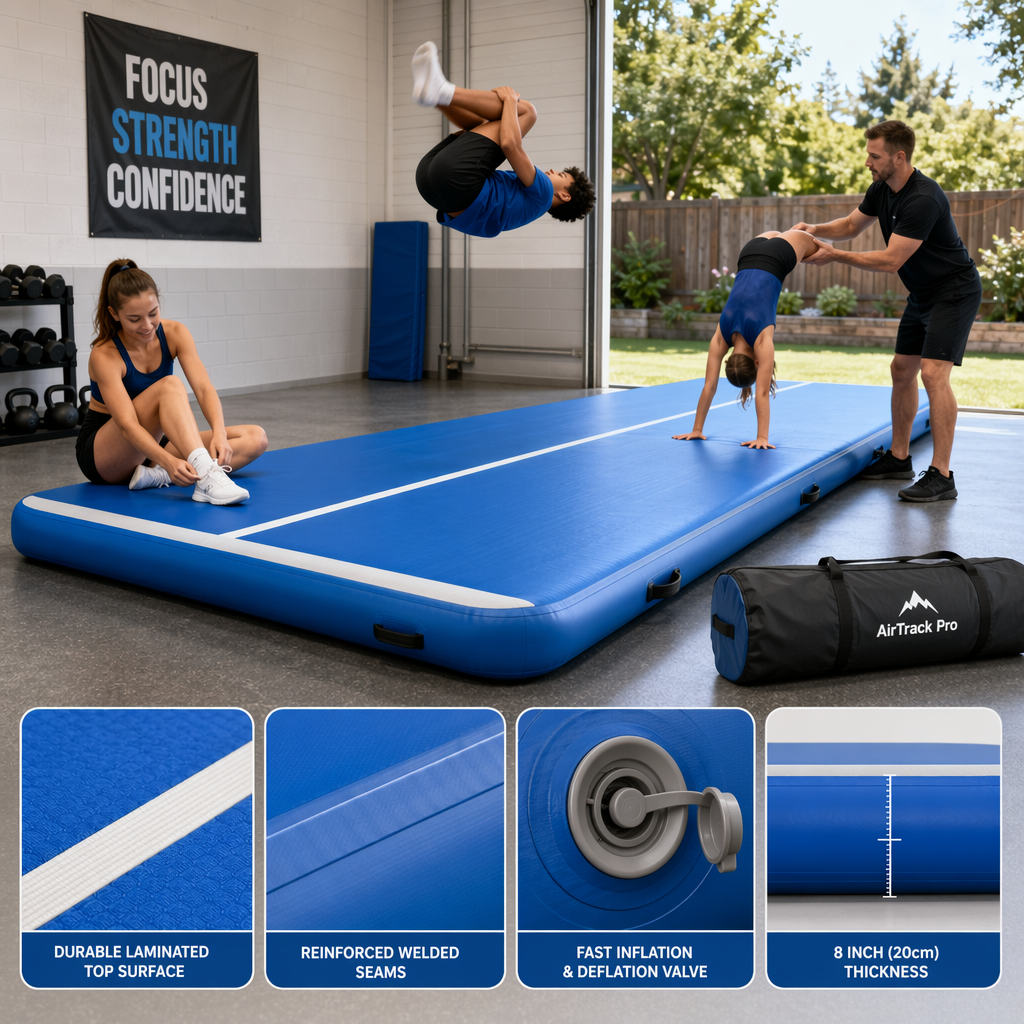
Construction and inflatable gym mat durability: materials, seam technology, and load capacity that ensure stable, long-lasting practice
The inflatable gymnastics air track mat delivers a resilient, buoyant surface that reduces joint stress and refines landings through consistent energy return. Constructed from high-grade drop-stitch PVC and fortified with reinforced welded seams, it resists abrasion and delamination even under repetitive impact. Internally, a dense lattice of vertical filaments maintains uniform tension, preventing sag and ensuring a predictable rebound for tumbling, conditioning, and progressive skill work.
Its load capacity accommodates solo and partnered drills; the platform remains dimensionally stable across a wide range of bodyweights, which supports safe repetition and motor patterning. The exterior laminate is treated to resist UV degradation and surface scuffing, extending service life for school, club, or home environments.
Inflation is rapid with a high-volume pump, and valves seal tightly to preserve pressure during extended sessions; when deflated the mat rolls compactly for transport or storage, adding logistical versatility. The combination of a springy, cushioned top and firm underlying tension makes this apparatus suitable for warmups, basic progressions, and advanced tumbling.
Durable construction and thoughtful engineering create a dependable practice surface that promotes confidence, reduces injury risk, and accelerates technical development. Inflatable
Springy training mat benefits for joint protection and improved landings: cushioning, rebound response, and injury reduction during conditioning
An inflatable air track mat delivers a resilient, springy surface that markedly attenuates impact forces, offering superior joint protection during repetitive tumbling and conditioning. The viscoelastic cushioning and high-rebound response support cleaner landings and quicker proprioceptive feedback, facilitating neuromuscular learning for both novices and advanced practitioners. Portability allows sessions to migrate from home to gymnasium without compromising training fidelity; the mat deflates and rolls compactly for facile transport and storage. Durable laminated fabric and reinforced seams provide a stable platform that resists shear and abrasion while maintaining consistent inflation pressure for predictable rebound characteristics. Coaches can design progressive drills—power takeoffs, back handsprings, aerials—with reduced musculoskeletal strain and a lower incidence of acute impact injuries. Warmups become more dynamic, and floor routines benefit from amplified lift and controlled descent. The mat’s combination of shock mitigation, elasticity, and structural integrity makes it an indispensable apparatus for safe skill progression and sustained athletic development.
inflatable air track mat
Portability and setup for home, school, and club use: inflation, deflation, rolling storage, and transport considerations
Lightweight yet robust, this inflatable mat provides a springy training surface that cushions landings and mitigates joint strain. Rapid inflation and deflation streamline sessions, while rollable storage and compact transport enable versatile use across homes, schools, and clubs. Durable lamination and stable air chambers support conditioning, drills, warmups, and progressive skill acquisition.
Progression-focused features for skill progression air track: size options, surface grip, and how the mat supports drills from basics to advanced tumbling
Featuring variable lengths and widths to suit beginners through elite athletes, a durable inflatable mat creates a controllable environment for incremental skill acquisition. The dense, springy core absorbs impact and lessens joint stress, allowing athletes to attempt higher amplitude tumbling with diminished injury risk. Surface tackiness enhances foot and hand grip without sacrificing easy pivots, so progressions from cartwheels to full twisting layouts remain secure.
Its portability means drills can be moved from gym to backyard or classroom, facilitating frequent, focused repetition essential for motor learning. The mat supports conditioning circuits and plyometric exercises, offering a consistent rebound that refines timing and aerial awareness. Reinforced seams and abrasion-resistant top layers provide longevity under repetitive landings and gymnastics hardware.
Coaches value the mat for its repeatable bounce profile, which simplifies cueing and measurable progression across sessions. Safety features such as low-profile edges and adjustable inflation enable customization of stiffness for rehabilitation work or high-difficulty routines. The combination of a cushioned, springy surface and stable planarity makes this equipment ideal for warmups, skill refinement, and safe floor routines at every stage of development. inflatable air track mat
How a Portable Gymnastics Air Track for Schools Clubs and Training Sessions Enhances Practice Efficiency
Improving Skill Progression and Safety with a Cushioned, Springy Surface for Basic to Advanced Routines
Portable air tracks transform practice environments by delivering a resilient, cushioned plane that mitigates landing shock and accelerates motor learning. Ideal for home gyms, schools and clubs, the inflatable surface promotes repeated tumbling with diminished joint strain, enabling longer, more focused sessions. Coaches can sequence drills from basic rolls to complex aerials while preserving athlete safety through consistent rebound and even energy return. The mat’s lightweight, rollable design simplifies logistics for multi-venue programs and impromptu warmups, making progression plans more fluid. Durable laminates and reinforced seams render a stable training platform for conditioning, spatial awareness exercises, and skill transference across apparatus work. Incremental confidence builds as practitioners experience safer landings and reliable takeoff dynamics. For pedagogical settings, this equipment fosters systematic repetition, reduces injury vectors, and refines kinesthetic feedback. The result is improved technique acquisition, smoother skill progression, and a pragmatic solution for sustainable, high-frequency practice.
Quick Setup and Transport: Portable Inflatable Tumbling Mat Benefits for Schools and Clubs
Portable inflatable tumbling mats streamline training by offering a swift inflate-deflate routine that maximizes scarce practice time. Lightweight yet robust, the mat unrolls for rapid deployment and provides a resilient, rebound-rich surface that cushions landings and diminishes cumulative joint stress. Coaches appreciate predictable rebound characteristics for consistent skill acquisition and progressive conditioning drills. The mat’s compact packability facilitates interclass rotation, outreach clinics, and seamless storage between sessions.
Durable construction withstands repeated impact while maintaining surface integrity for basic to advanced elements. The standout attribute is the inflatable air track, which harmonizes safety, portability, and performance.
Design Considerations and Durable Construction That Support Conditioning, Drills, and Repetitive Practice
The inflatable track provides a resilient, air track mat surface that absorbs impact and fosters safer landings for tumbling and conditioning. Its springy topology reduces stress on ankles and knees, enabling athletes to repeat drills with diminished fatigue and lower injury risk. Portability transforms training logistics: easy inflation and compact rolling allow rapid setup for warmups, skill progression, and circuit work in gyms, classrooms, or open halls. Durable, welded seams and reinforced fabric yield a stable practice plane that resists abrasion and sustains repeated dynamic loads, making it suitable from introductory drills to advanced acrobatics. Coaches benefit from predictable rebound characteristics that expedite motor-learning and refine technique through high-volume repetition. The mat’s versatility supports plyometrics, tumbling passes, and choreography, while dampening vibrations that can disrupt proprioceptive feedback.
Routine maintenance is minimal, and the unit’s lightweight form factor simplifies storage and transport between sessions, optimizing time-on-task and enhancing overall practice efficiency.
Optimizing Training Sessions: Air Track Training Session Setup for Warmups, Spotting, and Joint Impact Reduction
Portable air tracks transform practice efficiency by creating a consistent, resilient surface that mitigates impact and accelerates skill acquisition. Coaches can set up a linear training corridor for tumbling drills, progressive bounding, and conditioning circuits in minutes, then deflate and stow the mat to conserve space. The air track mat provides a springy rebound that cushions landings, lessening cumulative joint stress and enabling higher repetition with reduced fatigue. Incorporate it into warmups for plyometric priming, use it as a safe spotting platform during partner-assisted flips, or deploy shorter lengths for drill-specific isolation work such as round-offs and whip progressions. Durable welded seams and a non-slip topskin maintain stability under dynamic loads while permitting ambulatory transitions across apparatus. Versatility extends from basic skill consolidation to advanced sequence refinement, making sessions more time-efficient, ergonomically safer, and better suited to variable group sizes and facility constraints.
This pragmatic tool enhances both technique fidelity and athlete longevity.
Choosing the Right Size, Firmness, and Maintenance Tips for Long-Lasting Performance
Selecting the Right Size: a Practical Sizing Guide for Longevity and Safe Skill Progression
When choosing an inflatable gymnastics air track mat, size and firmness are pivotal for safety and progression. For novices and home practice, a shorter mat (6–10 ft) provides a manageable runway for drills and landings without compromising control. Intermediate and advanced athletes benefit from longer lengths (12–20 ft) to develop series tumbling and complex pass work. Width matters too; wider mats afford lateral freedom for choreography and multi-athlete use, while narrower options conserve space. Consider mat thickness as the primary determinant of rebound: thinner profiles (4–6 in) offer moderate spring suitable for basic skills and conditioning, whereas thicker units (8–16 in) deliver pronounced restitution for high-impact tumbling and aerials.
Firmness is adjusted by inflation pressure. A firmer surface improves rebound and shortens contact time, aiding power development and sharper landings; a softer setting increases absorption, reducing stress on joints during repetitive landings. Use a pressure gauge and incremental inflation to achieve the optimal balance between spring and shock attenuation.
Maintenance ensures long-lasting performance. Inspect seams and valves regularly for delamination or microtears and reseal promptly with compatible adhesive. Clean the mat with a mild, pH-neutral detergent and avoid abrasive tools that abrade the PVC coating. Store rolled with moderate tension in a climate-controlled space to prevent polymer creep and UV degradation. Periodic pressure checks compensate for temperature-induced variances in tension. Inflatable gymnastics air track mat selection and stewardship preserve safety margins and enable steady skill progression across basic drills to advanced tumbling sequences.
Finding Optimal Firmness Selection for Different Skill Levels and Joint Protection
Selecting the correct size and inflation level balances safety, performance, and training goals. Larger mats grant extended run-ups and combination tumbling, while compact versions suit technical drills and confined spaces. For beginners and those recovering from impact injuries, a slightly softer, more forgiving inflation mitigates joint stress and fosters confidence. Advanced athletes benefit from firmer inflation that enhances rebound and promotes precise landings. Periodically inspect seams and valves and perform pressure checks; environmental temperature alters firmness, so adjust accordingly. Store deflated, rolled, and dry to prevent delamination. The most important factor for longevity and safe progression is the inflation level.
Construction and Mattress Durability Factors: Materials, Seams, and Load Capacity Explained
Selecting the optimal size and firmness for an inflatable gymnastics air track mat hinges on intended use and athlete profile. For toddlers and beginners a shorter, softer mat provides forgiving resilience; advanced tumblers benefit from longer, firmer surfaces that deliver pronounced rebound for complex tumbling passes. Consider room dimensions, storage constraints, and transportability when choosing length and thickness. Maintenance preserves performance: regularly inspect seams and valves, avoid abrasive surfaces, and use a noncorrosive pump at recommended PSI to prevent overinflation. Construction quality affects longevity—mats made from welded drop-stitch PVC with reinforced rails resist delamination and maintain a uniform bounce. Stitch density, seam bonding technique, and laminate layering determine how the mat tolerates repeated shear and compression. Load capacity matters for partner drills and conditioning; ensure the rated maximum weight exceeds combined user loads. The most important keyword for durability and training utility is air track mat.
Routine caretaking and measured inflation keep the practice surface stable and safe for progressions.
Maintenance and Care Tips to Preserve Bounce, Prevent Leaks, and Extend Service Life
Selecting appropriate dimensions and inflation pressure ensures safe progression and optimal rebound for tumbling. Inspect seams, valves, and fabric regularly and perform pressure checks. Patch kits and seam sealant address microperforations. Store rolled without creases in a cool, dry place.
Proper maintenance preserves bounce and extends service life.
For a deeper understanding of impact biomechanics and tissue loading that informs appropriate firmness and padding choices, consult research-based guidance from academic sources such as the University of California Berkeley Ergonomics Lab, which discusses how surface compliance affects joint kinetics and injury risk https://ergonomics.berkeley.edu/impact-bio. Integrate this evidence by calibrating inflation to minimize peak ground reaction forces during repetitive landings, use incremental PSI adjustments with a calibrated gauge, and adopt prophylactic maintenance routines—microseal inspections, thermal-managed storage, and controlled roll tension—to retard polymer creep and delamination, thereby preserving dynamic restitution and structural integrity over prolonged service life.
Training Applications: Conditioning, Drills, Warmups, and Progression from Basics to Advanced Skills
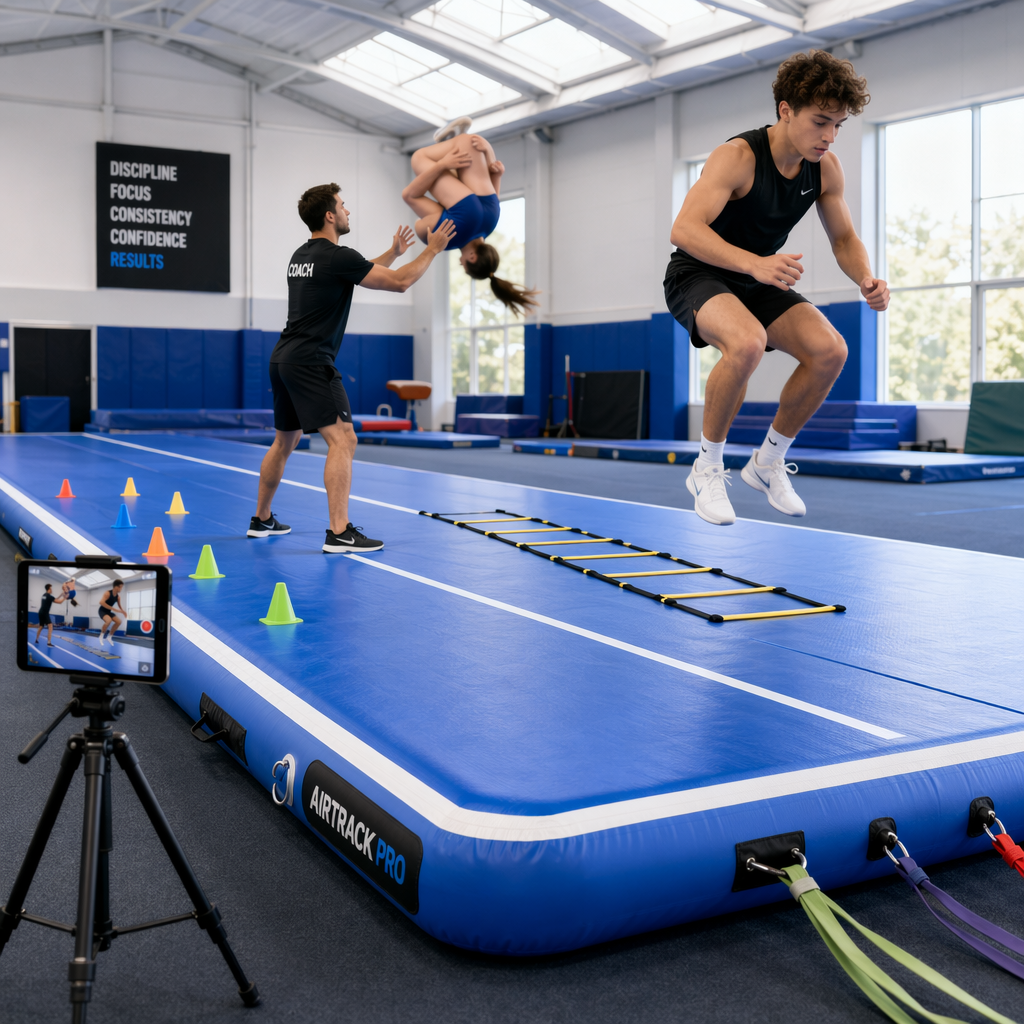
Building Sport-Specific Conditioning Routines on an Inflatable Gymnastics Air Track Mat to Enhance Power, Agility, and Endurance
The inflatable air track mat creates an adaptable environment for systematic conditioning, progressive drills, and warmups that bridge rudimentary techniques to complex tumbling sequences. Its forgiving, springy surface reduces eccentric loading on ankles and knees, permitting higher-repetition plyometrics and power development without excessive joint stress. Incorporate short, intense bouts of rebound jumps and tuck hops for neuromuscular potentiation, followed by agility ladders or cone patterns placed on the mat to refine multi-planar footwork.
Complex skill acquisition benefits from segmented practice: break a tumbling pass into approach, takeoff, aerial phase, and landing. Use truncated drills—run-and-pop entries, snap-down sets, and harnessed spot-to-land repetitions—to ingrain motor patterns. The mat’s slight give encourages more expressive aerial rotation while providing a reliable proprioceptive feedback loop that sharpens spatial orientation. Conditioning circuits combine core-centric holds, resisted band work anchored to the mat edge, and dynamic stability sequences to enhance the posterior chain and shoulder girdle, essential for vaults and vault-adjacent drills.
Warmups exploit the mat’s thermal neutrality; perform mobility flows, active isolated stretches, and de-loading bounding to prime connective tissue. For progression, employ graded difficulty: elevate complexity by increasing amplitude, adding twist elements, or reducing assistance. Use error-amplification drills early, then transition to closed-skill consolidations under fatigue to simulate competitive conditions. The durable construction holds form under repetitive loading, enabling repeatable micro-dosing of practice volume. Overall, the mat fosters a safe, iterative training architecture that accelerates skill progression while minimizing overuse risk and enhancing landing mechanics through consistent, cushioned feedback.
Drill-Based Training Progression: Breaking Skills into Repetitions, Spotting, and Safe Skill Sequencing
Progressive conditioning on an inflatable air track optimizes motor patterns and minimizes impact during repetitive drills. Begin with foundational drills—rolls, cartwheel progressions, and hurdle steps—then layer dynamic elements such as plyometric bounding and aerial drills. Use targeted spotting and progressive spotting fades to safeguard skill acquisition while fostering proprioceptive confidence. Incorporate intervalized warmups to prime fascial elasticity and joint centration. Train sequencing by decomposing complex tumbling into micro-components and recombining them with increasing amplitude. The resilient, springy surface enhances landing mechanics and reduces arthralgic load, making the air track mat ideal for incremental progression from basics to advanced acrobatics.
Dynamic Warm-Up Routines and Activation Exercises That Leverage the Mat’s Springy Surface to Reduce Injury Risk
Progressive conditioning drills exploit the mat’s rebound to amplify proprioception and eccentric control, aiding joint resilience and cleaner landings. Combine plyometrics, coordination ladders, and skill-specific repetitions for incremental overload. Short activation circuits prime stabilizers and hip kinetics, while longer sequences cultivate endurance and technical fidelity for both rudimentary tumbles and complex acrobatics. air track
Progression from Basics to Advanced Skills: Structuring Reps, Feedback, and Gradual Load Increase for Reliable Landings
Structured practice on an inflatable air track accelerates motor learning by offering a forgiving, springy surface that reduces acute load on lower extremities while preserving proprioceptive cues. Begin sessions with dynamic mobilization and specific warmups on the mat to activate stabilizers and rehearse spatial orientation. Progression should pair high-repetition drills with focused feedback loops: isolate components, increase tempo, then reassemble into compound skills. Use video capture and tactile cues from coaches to refine kinesthetic awareness and optimize flight trajectories.
Intermediate work includes plyometrics, hurdle-to-tuck drills, and temporal sequencing exercises to build eccentric control and rebound efficiency. For advanced athletes, simulate competition sequences and add perturbation challenges to foster robust neuromuscular adaptations without excessive ground reaction forces. Periodize load by modulating rep density, rest intervals, and mat firmness to prevent overuse and encourage supercompensation.
Emphasize measurable benchmarks—consistent stick rate, reduced valgus collapse, and tighter body alignment—so progression is evidence-based rather than purely subjective. Incorporate conditioned repetitions at submaximal intensity to engrain motor patterns, then layer peak efforts with adequate recovery. The result is a reliable pathway from rudimentary shapes to complex tumbling, maximizing safety and the likelihood of clean, repeatable landings on a resilient practice surface. air track
American College of Sports Medicine: Proper progression, frequent short bouts of plyometrics on forgiving surfaces, and structured feedback are recommended to develop power, reduce injury risk, and improve landing mechanics in athletes—air-filled training surfaces like inflatable mats can reduce joint load while preserving proprioceptive cues during skill acquisition (ACSM Position Stand on Plyometric Training and Surface Considerations, 2019).
Conclusion
The inflatable springy mat delivers a resilient, high-rebound practice surface built from drop-stitch PVC and reinforced welded seams that resists abrasion, preserves pressure, and supports solo or partnered drills. Its cushioning and predictable rebound reduce joint stress, improve landing mechanics, and accelerate motor learning across warmups, conditioning, and tumbling progressions. Portability and rapid inflation make it practical for homes, schools, and clubs, while rollable storage and durable laminates simplify transport and longevity. Size, thickness, and inflation pressure tailor firmness for beginners, rehabilitating athletes, or advanced tumblers, enabling safer repetitions and progressive skill sequencing. Routine maintenance—pressure checks, seam inspection, mild cleaning, and climate-controlled storage—preserves bounce and prevents delamination. Coaches benefit from a consistent platform for spot-assisted drills, plyometrics, and measurable progression markers that enhance technique fidelity and reduce injury risk. Overall, the air track mat is a versatile, durable tool that optimizes training efficiency, supports gradual load increases, and fosters reliable, repeatable skill development.