
Reading Time: 20 minute(s)
Transform summer days on the lake or pool into unforgettable launch-and-splash adventures with this inflatable water blob built for jumping and high-flying fun. Engineered as a durable bouncy platform, it provides a safe, buoyant surface to catapult riders into the water, turning ordinary outings into energetic games and memorable moments. Quick to inflate with a compatible air pump and simple to attach to boats or float near beaches and waterfront party areas, it offers convenience without compromising performance. Constructed from robust materials to resist punctures and withstand repeated use, the water blob suits family gatherings, group events, and rental setups alike. Lightweight for transport yet sturdy when in use, it promises hours of excitement for kids and adults, creating dynamic play experiences and picture-perfect splashes that elevate any summer celebration.
Content Summary
- Features and benefits of an inflatable water blob for lakes and pools high-flying launching platform
- Design and safety features of the inflatable water blob: durable bouncy platform, impact-absorbing landing blob construction, reinforced seams, and weight distribution for stable launches
- How the inflatable water launch pad creates high-flying thrills: mechanics of launching riders, positioning, teamwork techniques, and ideal rider-to-jumper ratios
- Setup, inflation, and maintenance: easy setup with an air pump, inflation tips, storage, patching and care for long-term lake and pool use
- Best use scenarios and activity ideas for lakes, pools, and waterfront parties: games, age-appropriate play, safety zones, and integration with boating or beach outings
- Step-by-step guide: how to set up and use a water blob with air pump for jumping
- Preparing the site and equipment: choosing a safe water area, checking depth and currents, and gathering an air pump for inflatable water toys plus anchors and repair kit
- Step-by-step inflation and installation: how to inflate the water blob with an electric or manual air pump, seal valves correctly, position and secure the inflatable water jump pad in lakes or pools
- Proper use and launching technique: how to board, time the jump, and coordinate launchers and riders to maximize height while minimizing risk
- Essential safety protocols and maintenance: safety tips for water blob jumping, weight limits, supervision, emergency procedures, cleaning, and storage
- Durability, materials and maintenance to keep your bouncy platform safe and long-lasting
- Constructive Materials and Reinforcement: Understanding Heavy-duty Fabric Reinforcement and Seam Design for Long-Lasting Bounce
- Protective Coatings and UV Care: Maintaining UV-resistant Surface Coatings to Prevent Fading, Cracks, and Material Breakdown
- Routine Safety Inspections and Patch Repairs: Pre-use Checks, Identifying Wear Points, and Proper Repair Techniques
- Anchoring and Weather Considerations: Choosing Weatherproof Anchoring Systems and Best Practices for Secure, Stable Use on Lakes and Pools
- Waterfront safety tips and best practices for group play and supervised launching
- Establishing Waterfront Group Safety Protocols: Roles, Communication Signals, and Supervision Ratios for Blob Jumping
- Shoreline Emergency Response Procedures: Quick-Action Plans, First Aid Supplies, and Rescue Equipment Placement
- Pre-Launch Checklist and Supervised Boat Launching Checklist: Inflatable Inspection, Weight Limits, Pumping, and Safe Launch Techniques
- Risk Management for Group Water Recreation: Age-Appropriate Rules, Alcohol Policies, and Weather or Water Condition Assessments
- Final Thoughts
Features and benefits of an inflatable water blob for lakes and pools high-flying launching platform
Design and safety features of the inflatable water blob: durable bouncy platform, impact-absorbing landing blob construction, reinforced seams, and weight distribution for stable launches
The inflatable water blob is engineered to turn ordinary lake days into adrenaline-rich gatherings by combining buoyant propulsion with considered safety engineering. Constructed from heavy-duty, puncture-resistant PVC and fortified with reinforced seams, the platform endures repeated launches while resisting abrasion from docks and rocky shorelines. Strategic internal baffle placement and an impact-absorbing landing blob geometry distribute force evenly, minimizing sudden torque and keeping riders stable during high-arc ejections.
Short bursts of elasticity provide the bouncy responsiveness that makes launches spectacular, while a broader footprint and multiple tether points ensure balanced weight distribution when two or more jumpers coordinate timing. Integrated grab handles and peripheral attachment rings facilitate secure mooring and controlled retrieval, and bright colorways enhance visibility for boats and swimmers.
Inflation is rapid with a standard air pump, and the material tolerates UV exposure and chlorinated environments better than basic vinyl alternatives. Routine inspection of seams and valves is simple, reducing maintenance downtime and prolonging service life. The design language favors predictable rebound and controlled descent, helping reduce impact stresses on the body upon water entry. For group play, the combined features create a reliable, high-flying launching platform that prioritizes stout durability and calculated performance during waterfront revelry. inflatable water blob
How the inflatable water launch pad creates high-flying thrills: mechanics of launching riders, positioning, teamwork techniques, and ideal rider-to-jumper ratios
The inflatable water blob transforms calm lakes and pools into a launching arena, combining buoyant engineering with playful kinetics to send riders soaring. Placing one rider near the far end while another jumper concentrates mass and velocity at the opposite end creates a catapult effect; timing and stance are decisive. Optimal positioning means the rider sits centrally on the distal zone while the jumper leaps from a firm, upright posture to maximize impulse transfer. Teamwork techniques include synchronized counts, clear hand signals, and staggered jumps to modulate height safely. Ideal rider-to-jumper ratios usually favor one rider to one jumper for predictable arcs, though larger blobs tolerate two jumpers for complex stunts if weight distribution is managed. The durable, airtight membrane offers a resilient, bouncy platform that resists abrasion and puncture, enhancing longevity during repeated launches. For setup, an air pump rapidly attains operational pressure, enabling quick deployment for spontaneous waterfront revelry and thrill-seeking social gatherings.
inflatable water blob
Setup, inflation, and maintenance: easy setup with an air pump, inflation tips, storage, patching and care for long-term lake and pool use
An inflatable water blob transforms ordinary waterfront gatherings into an adrenaline-laced tableau, offering a resilient, buoyant stage that catapults riders skyward when someone launches onto the opposite end. The robust PVC laminate resists punctures and abrasion, giving families and friends a dependable platform for synchronized jumps and impromptu acrobatics. Lightweight yet sturdy, it folds compactly for transport and inflates rapidly with an electric air pump, minimizing downtime so playtime starts sooner.
Setup calls for a level drop-in placement, secure anchoring with water-rated tethers, and gradual pressurization to avoid overinflation. For upkeep, rinse freshwater to remove grit, dry thoroughly to prevent osmosis, and store in a cool, opaque container away from UV exposure. Minor breaches are remedied by vulcanizing patches or adhesive repair kits designed for coated fabrics. Periodic inspections of valves, seams, and tether points preserve longevity, ensuring the platform remains a high-flying centerpiece for boating days, beach outings, and waterfront revelry.
Best use scenarios and activity ideas for lakes, pools, and waterfront parties: games, age-appropriate play, safety zones, and integration with boating or beach outings
The inflatable water toy creates an exhilarating focal point for aquatic recreation, functioning as a high-flying launching platform that propels riders skyward when someone lands on the opposite end. Its resilient, air-filled surface offers a buoyant trampoline effect ideal for synchronized splashes, stunt launches, or casual bouncing during leisure swims. Best suited for calm lakes, protected bays, and backyard pools, it integrates seamlessly with boating days and waterfront parties, adding kinetic energy without complex rigging. Age-appropriate use is essential: designate a clear splash zone, enforce one-jumper-at-a-time rules for young children, and establish a deep-water landing area for advanced tricks. Games can include timed launch contests, partner launches, or precision-landing challenges that use floatation markers. Safety measures such as spotters, life vests for novices, and periodic inflation checks preserve structural integrity. Lightweight to set up with a portable air pump, this durable recreational platform enhances group dynamics and creates memorable, photogenic moments on the water.
Step-by-step guide: how to set up and use a water blob with air pump for jumping
Preparing the site and equipment: choosing a safe water area, checking depth and currents, and gathering an air pump for inflatable water toys plus anchors and repair kit
Choose a broad, obstruction-free water zone with depth of at least 8–10 feet and minimal currents; inspect for submerged hazards and ensure shore access for emergency exit. Lay out the deflated blob on a clean, flat surface and connect a high-capacity air pump to the valve, inflating to a firm yet slightly pliant pressure to maintain bounce without over-stressing seams. Anchor the blob using recommended moor points and lines to prevent drift; add a repair kit and pump on standby. Designate a launcher zone and a landing zone, brief riders on weight limits and synchronized timing: one person sits at the far end while another jumps onto the opposite end to propel them skyward. Use a spotter in the water and staggered rotations to reduce collisions. After use, fully deflate, rinse with fresh water to remove grit, dry thoroughly to deter mold, and store in a cool, ventilated container. inflatable water blob
Step-by-step inflation and installation: how to inflate the water blob with an electric or manual air pump, seal valves correctly, position and secure the inflatable water jump pad in lakes or pools
Begin by laying the deflated pad on a smooth, debris-free surface near the water. Attach the nozzle of an electric or manual air pump to the valve and inflate in stages to avoid over-stressing seams; firm but pliant is the target. Once the bladder feels evenly pressurized, close the valve and engage the secondary cap or leash to ensure an airtight seal. Transport the inflated blob on its side and slide it gently onto the water, positioning it in a shallow, obstruction-free zone for initial use. Anchor with water weights or secure tethers to a dock to prevent drift, and maintain clear landing approaches for riders. One person jumps onto the far end while another sits near the opposite edge to be launched; coordinate counts and signals to manage timing and avoid collisions. Regularly inspect seams and valves for micro-leaks and re-inflate as needed to preserve the water blob bounce and ensure safe, high-flying fun.
Proper use and launching technique: how to board, time the jump, and coordinate launchers and riders to maximize height while minimizing risk
Begin by anchoring the inflated platform in calm water and inflate to firm pressure with an electric air pump, leaving a slight give for rebound. Board from the side onto the center to stabilize the blob; launchers position at one end and synchronize timing. Count down and bend knees, using a compact tuck to concentrate force; rider kneels or sits near the opposite edge. Coordinated launches rely on rhythm: a brief hop from the launcher at the apex of the rider’s crouch maximizes transfer. Prioritize clear communication, life vests, and spotters to mitigate collisions and ensure buoyant, exhilarant aquatic play.
Essential safety protocols and maintenance: safety tips for water blob jumping, weight limits, supervision, emergency procedures, cleaning, and storage
Inflate the water blob with a pump until taut, anchor near shore, and verify buoyancy. One person lies near the far end while a jumper ascends the platform and leaps, launching riders skyward. Enforce weight limits and vigilant supervision, rehearse emergency retrievals, rinse, dry thoroughly, and store away from UV exposure.
For authoritative guidance on water safety practices and supervision that complement blob use, consult the U.S. Centers for Disease Control and Prevention drowning prevention recommendations, which emphasize constant adult supervision, life jacket use for non-swimmers, and assessing water conditions before aquatic recreation: https://www.cdc.gov/drowning/prevention/index.html
Durability, materials and maintenance to keep your bouncy platform safe and long-lasting
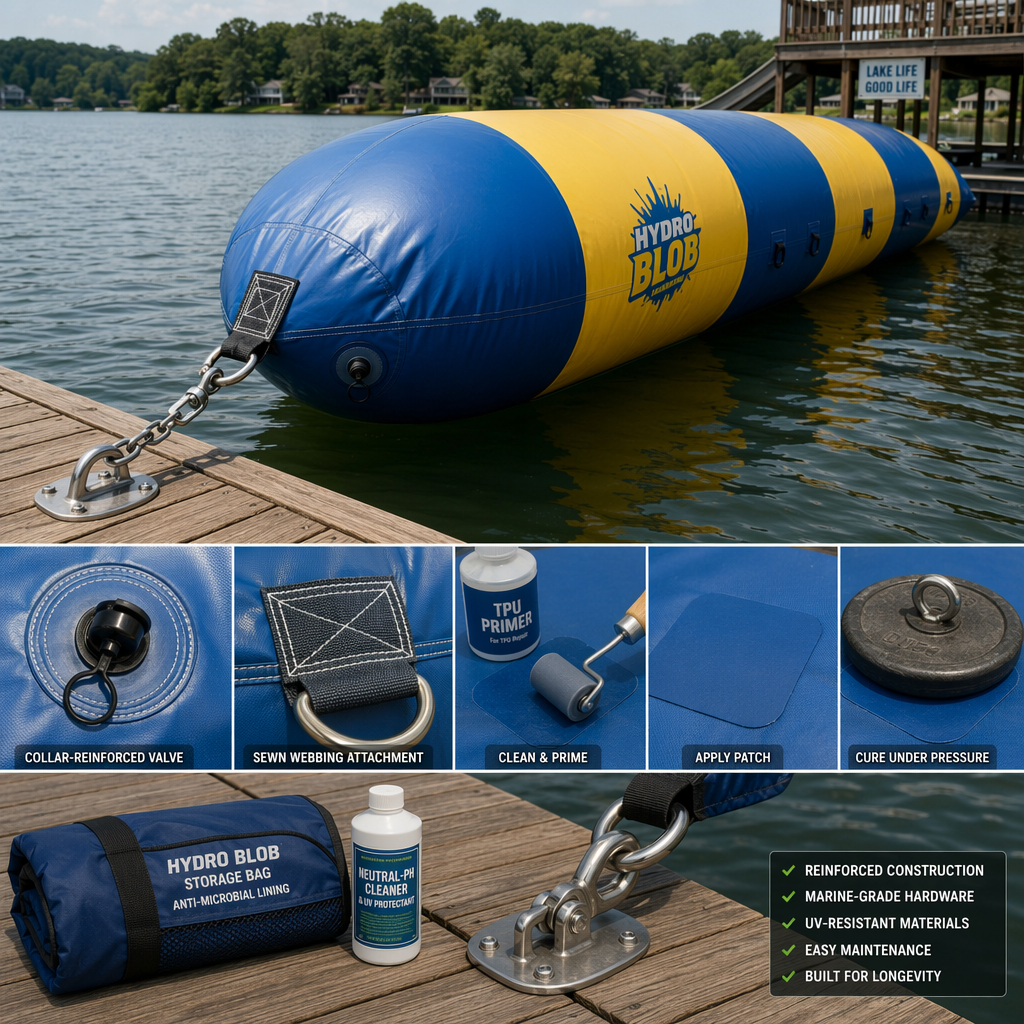
Constructive Materials and Reinforcement: Understanding Heavy-duty Fabric Reinforcement and Seam Design for Long-Lasting Bounce
The secret to a durable water blob lies in its core materials and thoughtful reinforcement. Manufacturers often use multilayered PVC or TPU laminates with a high denier rating to resist punctures and abrasion; these substrates combine pliability with tensile strength to keep the platform resilient under repeated impact. Reinforced stress zones feature welded or double-stitched seams, sometimes backed by an internal webbing grid that disperses loads across the bladder and prevents seam peel. Valves and attachment points are frequently collar-reinforced to avert tearing when riders are launched or mooring lines are tensioned.
Regular maintenance extends service life: rinse with fresh water after salt or chlorinated exposure, dry fully before storage to inhibit osmosis and mildew, and inspect seams, welds, and the inflation chamber for microabrasions. Minor repairs can be performed with patch kits matched to the material—adhesive-backed TPU or heat-bond patches are common—while larger damage may require professional vulcanization.
Storage in a cool, shaded environment away from petrochemicals and sharp objects minimizes polymer degradation. Routine inflation checks and pressure moderation ensure the platform remains bouncy without overstraining seams. Above all, attention to material specification and seam architecture ensures the inflatable water blob remains a safe, long-lasting centerpiece for aquatic play.
Protective Coatings and UV Care: Maintaining UV-resistant Surface Coatings to Prevent Fading, Cracks, and Material Breakdown
Routine care preserves both appearance and structural integrity of an inflatable water blob. Start by rinsing off chlorine, salt, and grit after each use to prevent abrasive degradation and pigment leaching. Inspect seams and vales for microtears; early detection of nitrile fatigue or delamination allows prompt patching before failures propagate. Apply a UV-resistant protectant formulated for PVC or TPU surfaces periodically to retard photodegradation and color fade. Avoid petroleum-based products that can embrittle materials and compromise welds. Store the deflated unit in a cool, shaded container with anti-microbial lining to reduce mold and ozone weathering during off-season. When inflating, adhere to manufacturer pressure ranges to prevent over-stressing the bladder and seams; thermal expansion on hot days can raise internal pressure significantly. Use gentle cleaners with neutral pH and soft brushes for stubborn stains. Proper maintenance extends service life and keeps the inflatable platform safe and buoyant for countless high-flying splashes.
Routine Safety Inspections and Patch Repairs: Pre-use Checks, Identifying Wear Points, and Proper Repair Techniques
Inspect the surface before each outing for abrasions, seam stress, or bulging that indicar potential failures. Pay attention to high-wear zones near valve clusters and jump edges; these are common fatigue points. Clean with mild detergent and fresh water, then air-dry completely to prevent osmosis and microbial growth. For minor punctures use a manufacturer-compatible patch kit and follow a two-stage adhesion method: abrade, apply primer, then affix patch and cure under pressure. Maintain recommended inflation pressure; underinflation increases flex fatigue while overinflation risks seam rupture. Document repairs and inspection dates to track the platform’s service life and ensure ongoing safety.
Anchoring and Weather Considerations: Choosing Weatherproof Anchoring Systems and Best Practices for Secure, Stable Use on Lakes and Pools
Regular inspection and proper maintenance are essential to preserve the structural integrity of an inflatable water blob. Clean the surface after each use to remove grit, algae, and sunscreens that can accelerate wear; a gentle detergent and freshwater rinse usually suffice. Patch kits and reinforced repair patches are indispensable for addressing abrasions promptly, and storing the blob dry and deflated in a ventilated, cool space prevents UV embrittlement and mold. Anchoring systems deserve special attention: choose corrosion-resistant hardware such as stainless steel shackles or marine-grade swivels paired with heavy-duty webbing or coated chain to resist chafe and electrochemical degradation. For lakes, use weighted anchors with anchor floats to prevent tangling; for pools, secure to fixed deck points with load-rated anchors and quick-release capability for emergency egress. Monitor weather conditions vigilantly — strong winds create dangerous uplift forces — and deflate or reposition the blob when sustained winds or storms are forecast. Routine torque checks and avoiding sharp surfaces extend service life and safety.
According to the U.S. Coast Guard Auxiliary Boating Safety division, proper maintenance, regular inspections, and using manufacturer-recommended repair methods are critical for inflatable watercraft safety, and owners should rinse off salt and chlorine, fully dry before storage, apply UV protectants compatible with PVC/TPU, and follow specified inflation pressures to prevent material failure and seam rupture
Waterfront safety tips and best practices for group play and supervised launching
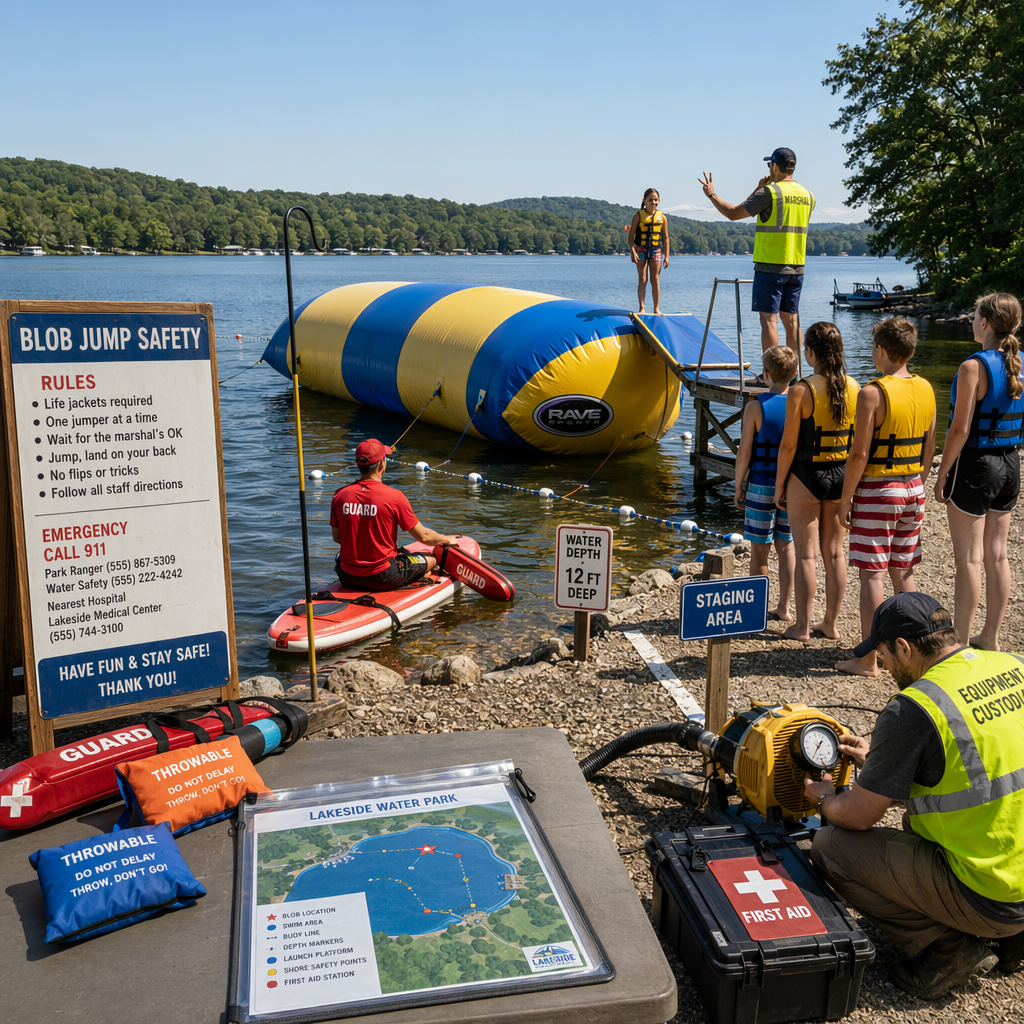
Establishing Waterfront Group Safety Protocols: Roles, Communication Signals, and Supervision Ratios for Blob Jumping
Before any blob session, designate clear roles: a launching marshal to authorize jumps, a safety spotter in the water to watch for collisions, and an equipment custodian to monitor inflation and tethering. Establish concise, visual and vocal communication signals — for example, a raised arm to indicate ready, two fingers for caution, and a loud whistle for immediate stop — so participants can react instantly across distances and ambient noise. Keep supervised groups small and age-appropriate; a recommended ratio is one trained guardian per four younger children, and one per six adolescents or adults when mixing skill levels.
Maintain a pre-launch checklist: inspect the inflatable surface for abrasions, ensure depth is sufficient for high launches, and confirm all swimmers have appropriate flotation if needed. Rotate riders to prevent fatigue, enforce staggered jumping to avoid pileups, and rehearse emergency retrieval procedures. Vigilant supervision, unambiguous signals, and role clarity transform high-flying fun into managed, memorable recreation.
Shoreline Emergency Response Procedures: Quick-Action Plans, First Aid Supplies, and Rescue Equipment Placement
Establish a clear emergency action plan before any group play begins: designate a responsible supervisor, assign specific roles for crowd control, swimmer accountability, and communication, and determine the quickest route to shore. Stow a well-equipped first aid kit within immediate reach and augment it with a cervical collar, a compact airway kit, and waterproof trauma shears for atypical injuries. Station buoyant rescue aids—rescue tubes, throwable cushions, and a rigid shepherds hook—at predictable intervals along the shoreline and on any floating platforms.
Conduct a brief safety huddle with participants to rehearse the protocol for failed launches, entanglement, or unconscious riders. Emphasize a conservative launching cadence so the launch end remains clear and the receiving area downrange is checked for swimmers and submerged hazards. Maintain a talismanic visual sweep: appoint a spotter whose sole task is to monitor for signs of hypothermia, dyspnea, or disorientation after high-velocity splashes.
Keep a laminated map of exit points, vehicular access, and local emergency numbers in a waterproof pouch. Train at least one person in CPR and use of an automated external defibrillator. Regularly inspect anchorage lines and inflation integrity to reduce mechanical failure during group maneuvers. Prioritizing preparedness preserves exhilaration while minimizing risk for every participant; the central tenet is shared responsibility and rapid, organized response.
Pre-Launch Checklist and Supervised Boat Launching Checklist: Inflatable Inspection, Weight Limits, Pumping, and Safe Launch Techniques
Before launching, inspect the inflatable for abrasions, seam stress, and proper valve seating; a pressure-tested surface reduces puncture risk. Verify weight limits and distribute riders to prevent asymmetric loading and capsize. Use a reliable air pump until the blob is firm but slightly pliant, avoiding overinflation that stresses seams. Designate a launch supervisor to coordinate countdowns, ensure clear splash zones, and enforce one jumper per end during each impulse.
Establish a rescue plan, buoyancy aids for non-swimmers, and situational awareness for boat traffic. Rotate participants to prevent fatigue and maintain visual contact at all times for safe, communal exhilaration.
Risk Management for Group Water Recreation: Age-Appropriate Rules, Alcohol Policies, and Weather or Water Condition Assessments
Supervised group launching requires clear protocols to minimize risk while maximizing fun. Establish age-appropriate rules: designate separate launching zones for children and adults, require basic swimming competence for participants, and limit simultaneous launches to prevent collisions. Implement strict alcohol policies; impairment degrades judgment and reaction time, so forbid consumption by operators and those waiting to launch. Conduct pre-activity assessments of weather and water conditions, checking wind speed, wave height, visibility, and hidden hazards like submerged rocks or sudden drop-offs. Use a buddy system and position spotters with flotation devices at strategic vantage points. Ensure the inflatable water blob is inflated to manufacturer pressure, anchored securely, and inspected for tears or valves before each session. Brief everyone on hand signals, safe landing techniques, and emergency procedures. Rotate participants to avoid fatigue, keep a first-aid kit nearby, and maintain clear communication via whistle or waterproof two-way systems for rapid response.
Final Thoughts
The inflatable water blob combines durable materials, reinforced seams, and thoughtful geometry to deliver reliable high-flying launches while minimizing impact stresses and abrasion. Constructed from heavy-duty PVC or TPU laminates with welded or backed seams, it resists punctures, tolerates UV and chlorinated environments, and inflates quickly with a standard air pump. Proper setup requires choosing deep, obstruction-free water, secure anchoring, staged inflation, and routine inspections of valves and tether points. Launch technique hinges on timing, positioning, and clear communication between rider and jumper, with recommended one-to-one ratios for predictable arcs and spotters to reduce collision risk. Maintenance includes rinsing, drying, UV protectants, patch repairs, and cool storage to prolong service life. Group play benefits from established roles, pre-launch checklists, emergency response planning, and strict age, weight and alcohol policies to manage risk. When cared for and supervised, the water blob becomes a dynamic centerpiece for safe, memorable waterfront recreation.