
Reading Time: 19 minute(s)
Discover top-quality inflatable bouncy castles and fun slides from Guangzhou designed to bring safe, durable excitement to parties, backyards, and rental fleets. These inflatables combine vibrant designs, reinforced materials, and meticulous stitching to meet rigorous safety standards while providing hours of active play. Whether planning a children’s birthday, community event, or expanding a rental business, choosing reliable manufacturers ensures UV-resistant fabrics, non-toxic PVC, and secure anchoring systems that stand up to repeated use. Many suppliers also offer customization options, rapid shipping, and responsive aftercare to simplify logistics and maintenance. Learn how to evaluate age-appropriate sizes, weight capacities, and certified safety features so every jump and slide stays worry-free. This guide highlights the practical benefits of Guangzhou-made inflatables and what to check before purchase to ensure long-lasting fun for kids and peace of mind for organizers.
Detailed Index
- Key Safety Features and Construction: mesh-walled bounce houses with reinforced stitching and blower system for reliable play
- Mesh-walled bounce houses with reinforced stitching: how mesh-sided inflatables safety features and reinforced seam durability bounce house work together to prevent falls and tears
- Commercial-grade blower integration and ventilation considerations: ensuring continuous inflation, proper ventilation, and adherence to commercial-grade blower safety standards
- Construction materials and reinforcement zones: vinyl and PVC coatings, double-stitched seams, and impact-resistant anchor points for long-lasting active play
- Design elements that promote safe play and supervision: mesh visibility, internal layout for supervised climbing and sliding, and barrier placement to control flow
- Designs That Encourage Active, Imaginative Play and Social Interaction in Backyard Inflatable Play Centers
- Design Elements That Promote Active, Imaginative Play Through Themed Slides, Climbing Zones, And Interactive Obstacles
- How Backyard Play Structures For Group Play Foster Social Interaction, Cooperative Games, And Turn-Taking Skills
- Sensory-Rich Inflatable Features: Textures, Bright Colors, And Sound Elements That Enhance Motor Skills And Engagement
- Practical Layouts And Creative Obstacle Course Layouts For Safe Flow, Supervision, And Age-Appropriate Challenge Levels
- Choosing the Right Size, Weight Capacity, and Age-Appropriate Layouts for Parties and Rental Use
- Matching Inflatable Dimensions to Event Space: How to Measure and Plan for Party Equipment Sizing
- Determining Safe Load: Understanding Rental Weight Limits and Capacity per Session
- Designing Age-Appropriate Layouts: Separate Zones for Toddlers, Young Children, and Big Kids
- Setup, Supervision, and Flow: Practical Tips for Placement, Entrances, and Emergency Exits
- Maintenance, Setup, and Storage Best Practices for Durable Commercial-Grade Inflatable Slide and Castle Rentals for Events
- Pre-Event Setup Checklist: Step-by-Step Inflatable Rental Setup Checklist, Proper Anchor Methods, Blower Placement, and Initial Safety Inspections
- Daily Maintenance and On-Site Safety Protocols: Event Bounce House Safety Protocols Including Staff Briefings, Supervision Zones, Weight and Capacity Controls, and Emergency Deflation Procedures
- Cleaning, Repair, and Fabric Care for Commercial-Grade Inflatables: Recommended Cleaning Agents, Patch Techniques, Reinforced Stitching Checks, and Routine Structural Inspections
- Long-Term Storage and Transportation Best Practices: Long-Term Storage Tips for Event Inflatables, Drying, Folding Methods, Climate-Controlled Storage, and Inspection Before Reuse
- Recap
Key Safety Features and Construction: mesh-walled bounce houses with reinforced stitching and blower system for reliable play
Mesh-walled bounce houses with reinforced stitching: how mesh-sided inflatables safety features and reinforced seam durability bounce house work together to prevent falls and tears
Mesh-sided inflatables pair visibility with containment, using fine yet robust netting to prevent falls while allowing supervisors unobstructed sightlines. Reinforced seam engineering—double or triple-stitched hems with bartack reinforcements—fortifies stress points against shear and abrasion, extending service life. Integrated blower systems maintain constant inflation pressure, ensuring a resilient, bouncy surface that absorbs impact and reduces injury risk. Strategic barrier placement and internal zoning create collision buffers and guided traffic flows for cooperative play. Together these elements yield a resilient, safe play environment that balances kinetic freedom with structural integrity, ideal for prolonged, active engagement in varied event contexts.
Commercial-grade blower integration and ventilation considerations: ensuring continuous inflation, proper ventilation, and adherence to commercial-grade blower safety standards
Mesh-walled bounce houses combine visible containment with airflow, creating a play environment where supervision and ventilation coexist. The mesh panels serve as a soft yet secure barrier that prevents accidental egress while allowing caregivers to monitor activity and maintain a safe spatial awareness of children at play. Reinforced stitching at high-stress seams and load-bearing anchor points reduces the risk of tear propagation during repetitive jumping and tumbling. Durable fabric laminates and high-denier materials resist abrasion and puncture, extending service life under frequent use.
Commercial-grade blower integration is pivotal for steady inflation performance; these blowers are engineered for continuous duty cycles and incorporate thermal overload protection to prevent motor burnout. Proper blower placement and protected air inlets ensure unobstructed airflow, while supplementary anchoring systems maintain structural tension to avoid sagging that could compromise slide angles or climbing gradients. Ventilation considerations include adequate exhaust paths and mesh porosity to prevent heat accumulation without sacrificing containment.
Adherence to commercial blower safety standards—such as grounding, fused power connectors, and weather-resistant housings—mitigates electrical and environmental hazards. Together, these construction and safety features foster an environment that encourages vigorous activity, coordination, and sociable play, with durability and operational reliability prioritized for frequent, public-facing use. reinforced stitching
Construction materials and reinforcement zones: vinyl and PVC coatings, double-stitched seams, and impact-resistant anchor points for long-lasting active play
Mesh-walled inflatables marry visibility with containment, letting supervisors monitor play while children enjoy resilient, cushioned bouncing. Reinforced stitching and gusseted seams mitigate seam failure under repeated impact, and strategically placed reinforcement zones absorb concentrated loads around entryways and climb lines. Durable laminated vinyl and PVC coatings resist abrasion and UV degradation, prolonging service life even with commercial rotation. Integrated blower systems maintain consistent pressure, while impact-resistant anchor points and low-profile tie-downs secure units against overturning.
These elements collectively prioritize the safety and longevity of active play equipment, fostering confident, energetic, and cooperative experiences for kids.
Design elements that promote safe play and supervision: mesh visibility, internal layout for supervised climbing and sliding, and barrier placement to control flow
Mesh-walled inflatables provide unobstructed sightlines so caregivers and attendants can monitor play with minimal intrusion, enabling rapid intervention if a tumble occurs. The transparent mesh also facilitates ventilation, reducing heat buildup within the chamber and helping to maintain a comfortable ambient microclimate for vigorous activity. Critical seams and contact zones are often engineered with reinforced stitching and bar-tack nodes to distribute stress from repeated impacts, which prolongs service life and mitigates seam failure during high-frequency use. Internal partitions and graduated platforms create a choreographed flow: children ascend via textured climb zones, traverse a cushioned plateau, then descend designated slide lanes. This orchestrated layout minimizes cross-traffic and reduces collision points.
Integral blower systems are specified to deliver consistent positive pressure and are frequently coupled with redundant inflation channels to preserve form even if one inlet temporarily falters. Anchoring arrays, such as integrated D-rings and heavy-duty tethers, secure the structure against lateral forces and gusts, complementing the soft restraint of mesh walls that act as passive fall arrestors. Barrier placement at slide exits and entry funnels regulates dwell time and prevents surges, while non-slip step surfaces and foam-capped edges attenuate impact energy.
Maintenance-friendly fabrics with high denier ratings resist abrasion and shed moisture, simplifying sanitation between uses. Together, these design choices create an environment that promotes active, coordinated play while prioritizing persistent supervision and mechanical reliability for a safer recreational experience for children.
Designs That Encourage Active, Imaginative Play and Social Interaction in Backyard Inflatable Play Centers
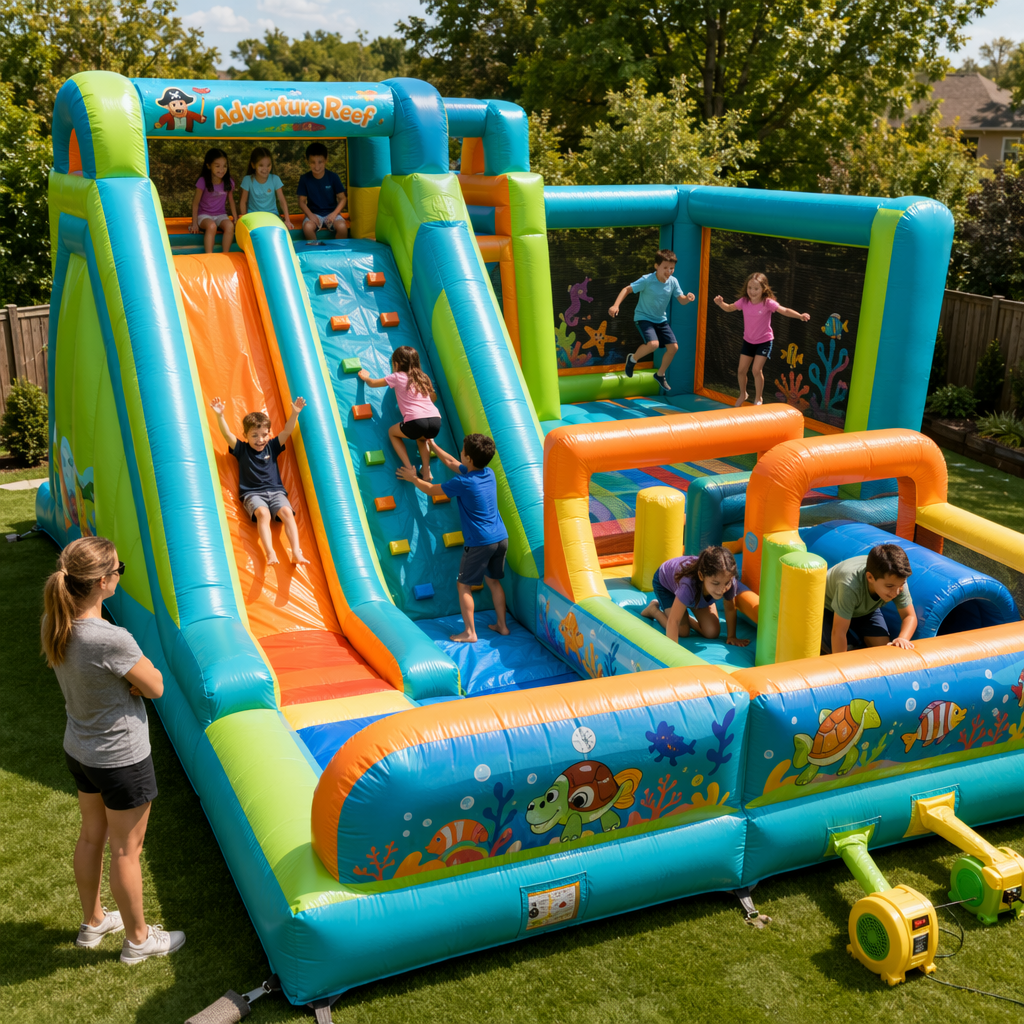
Design Elements That Promote Active, Imaginative Play Through Themed Slides, Climbing Zones, And Interactive Obstacles
Inflatable backyard play centers blend theatrical theming with kinetic features to foster vigorous, imaginative play. Brightly hued slides, tiered climbing zones, and obstacle courses invite children to test coordination and spatial reasoning while engaging in cooperative games. Reinforced seams and mesh barriers augment safety without dampening exuberance, and integrated blowers maintain resilient, springy surfaces that reduce impact. These structures function as social hubs where role-play scenarios flourish and motor skills are refined through repeated, varied movement. Practical for parties and rentals, they sustain prolonged engagement and encourage healthy exercise, creative problem-solving, and peer interaction.
inflatable
How Backyard Play Structures For Group Play Foster Social Interaction, Cooperative Games, And Turn-Taking Skills
Backyard inflatable play centers are crafted to spark energetic movement and inventive scenarios, blending soft, resilient platforms with tunnels, ramps, and slides that invite exploration. These modular terrains encourage children to practice gross motor skills through jumping and climbing, while the inclusion of distinct play zones fosters imaginative narratives and role-play. Cooperative tasks naturally emerge as kids negotiate turns on slides, form relay teams, or invent obstacle courses that require communication and shared rules.
Short bursts of vigorous activity alternate with calmer moments of strategic play, supporting attention spans and vestibular development. Safety-conscious design features such as elevated mesh barriers and cushioned landings reduce risk, allowing caregivers to feel assured while children experiment with physical limits. Rental operators and families alike value the quick assembly and deflation process, which makes group play readily accessible for parties and neighborhood gatherings.
Beyond exercise, these structures act as social catalysts: peers learn to resolve minor conflicts, practise turn-taking, and empathize with playmates during cooperative games. The lively environment sustains engagement for extended periods, transforming ordinary yards into arenas for skill-building, imaginative storytelling, and collective joy. The central benefit is clear—promoting active, communal play through thoughtfully engineered inflatable play centers.
Sensory-Rich Inflatable Features: Textures, Bright Colors, And Sound Elements That Enhance Motor Skills And Engagement
Backyard inflatable centers blend cushioned bounce zones with climbing obstacles and slides to foster vigorous play and cooperative games. Bright hues, varied textures, and occasional auditory cues stimulate proprioception and engagement, while mesh barriers ensure containment. These designs promote cardiovascular activity, dexterity, imaginative scenarios, and sustained social interaction among children.
inflatable
Practical Layouts And Creative Obstacle Course Layouts For Safe Flow, Supervision, And Age-Appropriate Challenge Levels
Thoughtful inflatable play centers blend imaginative motifs with pragmatic ergonomics to foster robust physical activity and convivial play. A well-conceived layout channels energy through climbing pods, bounce zones, and slide runs so children experience graduated challenges that respect age-specific motor skills. Strategic mesh walls and reinforced barriers maintain sightlines for supervisors while preventing accidental egress, and durable fabric with reinforced stitching ensures sustained resilience under repeated impacts. Modular obstacle-course permutations encourage cooperative problem-solving, turn-taking, and spatial awareness, transforming solitary bouncing into collaborative conquest. Many designs integrate blower-compatible chambers for continuous inflation and rapid deployment, simplifying setup and teardown for caregivers or event staff. The cumulative effect is a safe, dynamic environment that promotes cardiovascular exercise, coordination, and narrative-driven role play, keeping youngsters engaged for extended intervals. Emphasizing user flow, risk mitigation, and playful complexity, these inflatables serve as versatile attractions for backyards, parties, and rental programs seeking to elevate active, supervised entertainment.
inflatable
Choosing the Right Size, Weight Capacity, and Age-Appropriate Layouts for Parties and Rental Use
Matching Inflatable Dimensions to Event Space: How to Measure and Plan for Party Equipment Sizing
Measure the usable area, then subtract clearance for anchors and blower access to determine inflatable footprint; this avoids obstruction and ensures safe ingress and egress. Consider ceiling height, gate widths, and overhead hazards when planning vertical elements such as towers or slides. Account for operational space around the blower and a perimeter for supervision and emergency access. Weight limits and occupancy ratings are pivotal — match the manufacturer’s weight capacity to anticipated age groups and number of simultaneous users to prevent overstressing seams and air pressure systems. For rental fleets, favor modular layouts with segregated toddler zones and more vigorous youth sections to minimise collision risk and accommodate mixed-age bookings. Choose age-appropriate internal features: low-rise steps and soft barriers for preschoolers; steeper climbs and longer runs for older children, with mesh walls for fall containment. Quick setup and takedown logistics reduce turnaround time, while reinforced fabrics and industrial stitching elevate longevity for repeated use.
Determining Safe Load: Understanding Rental Weight Limits and Capacity per Session
Selecting inflatables for parties or rental fleets demands attention to size, weight capacity and layout to ensure both fun and safety. Consider floor footprint and ceiling clearance to match event spaces; compact castles suit backyards while larger modules fit parks and halls. Calculate concurrent users using the manufacturer stated gross load and divide by average child weight to determine a practical session limit. Factor in kinetic forces from bouncing—reinforced seams and robust anchors mitigate structural strain. Layouts should be age-segregated: toddler-friendly zones with low slides and soft barriers, and more elaborate obstacle arrays for older children to challenge coordination. Incorporate clear ingress/egress paths and supervise sightlines to reduce crowding. For rental turnover, choose units with efficient blower ports and rapid deflation for quick teardown. Emphasize maintenance: periodic patching, seam inspection, and UV-resistant coatings extend service life. The overriding priority is predictable, controlled use to preserve safety and maximize enjoyment for every group.
Designing Age-Appropriate Layouts: Separate Zones for Toddlers, Young Children, and Big Kids
Selecting the proper inflatable for parties or hire hinges on assessing size, weight capacity and the spatial choreography of play areas to ensure both safety and sustained engagement. Larger units with higher load ratings permit simultaneous use by multiple children, but crowd management and clear capacity signage prevent overloading. Smaller units or compact combos suit intimate gatherings and backyards; portable blowers simplify setup and dismantling for rental rotations.
Designing age-appropriate layouts involves zoning: allocate a soft, shallow bounce area for toddlers with low walls and minimal obstacles; a mid-level zone combining gentle climbing challenges and short slides for young children; and a more expansive, reinforced section for big kids featuring taller slides and obstacle courses. Physical separation maintains developmental suitability and reduces collision risk. Mesh partitions, color-coded entrance points, and staggered entry schedules enhance flow.
Consider load-distribution patterns and anchoring systems when mixing age groups in adjacent modules to avoid undue stress on seams. Regular inspection of seam integrity, material abrasion and blower performance preserves longevity and safety. Beyond exercise, these configurations foster cooperative play and imaginative scenarios, while efficient layouts streamline supervision and turnover for events and rentals. The central consideration is always the weight capacity matched to the intended age cohort.
Setup, Supervision, and Flow: Practical Tips for Placement, Entrances, and Emergency Exits
Selecting inflatables for parties or rentals requires balancing dimensions, load limits, and age-appropriate configurations to ensure longevity and lively play. Opt for sizes that fit the venue while leaving clearance for anchoring and airflow; consider weight capacity per zone to prevent overstressing seams and bladder chambers. Younger children benefit from compact, low-rise layouts with gentle slopes and enclosed bouncing areas, whereas older kids enjoy multilevel castles with climbing walls and steeper slides that foster coordination and bold play. Supervision and placement are equally critical: situate inflatables on level ground away from hazards, maintain unobstructed entrances and exits, and preserve a clear perimeter for attendants.
Entrances should allow smooth ingress and egress to prevent bottlenecks, and emergency exits must be visible and unobstructed for quick evacuation. Trained supervisors should monitor occupancy and enforce age or weight groupings to minimize collision risk. Prioritize routine inspections of tie-downs, stitching, and the blower system to uphold a safe, exuberant environment. inflatables
Center for Disease Control and Prevention — Safe Kids and Safe Play Equipment Guidelines: Proper sizing, weight limits, supervised separation of age groups, and regular equipment inspection significantly reduce injury risk on inflatable play structures, and manufacturers’ stated weight capacities should be used to set occupancy limits and session planning.
Maintenance, Setup, and Storage Best Practices for Durable Commercial-Grade Inflatable Slide and Castle Rentals for Events
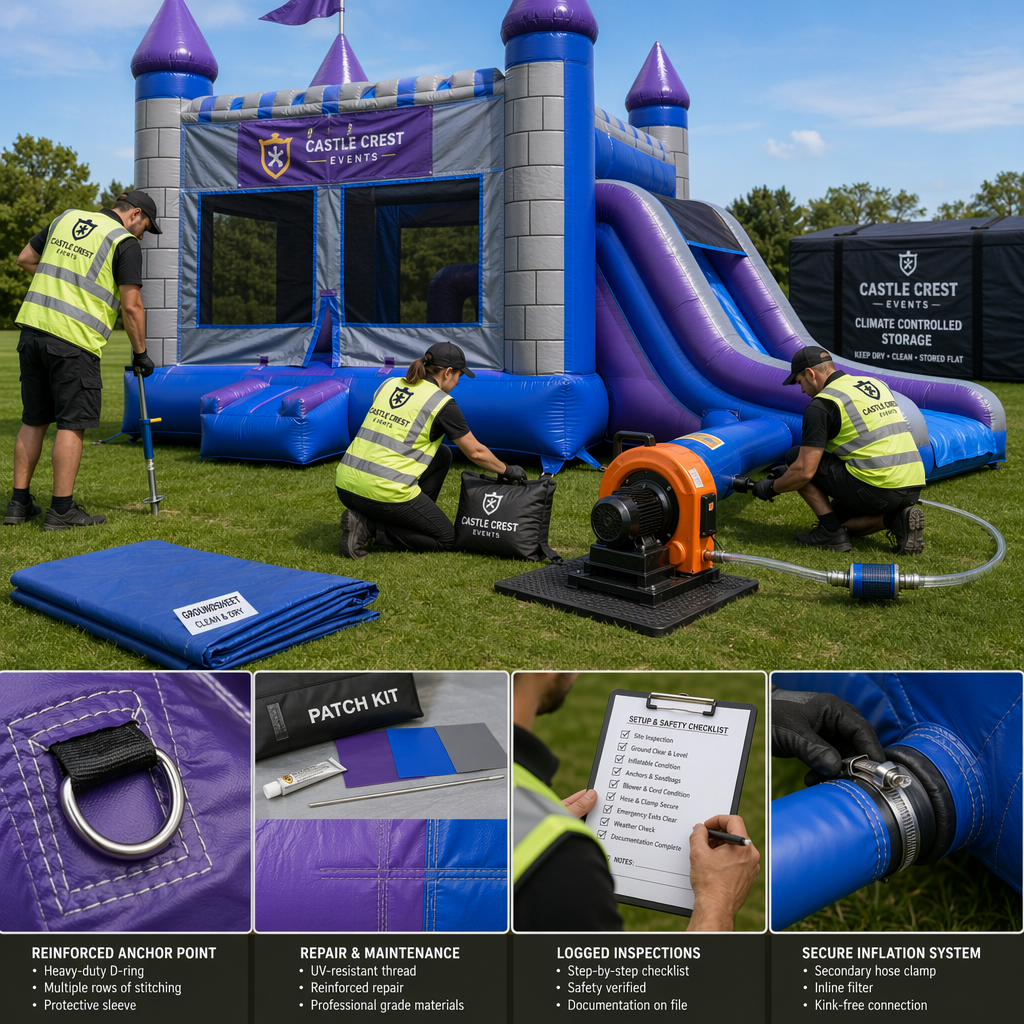
Pre-Event Setup Checklist: Step-by-Step Inflatable Rental Setup Checklist, Proper Anchor Methods, Blower Placement, and Initial Safety Inspections
Begin by surveying the site for level ground, debris, and underground utilities; a precise footprint prevents tension points and uneven wear. Lay out the deflated unit, inspect seams and D-rings, and verify the integrity of the blower and electrical cords. Use heavy-duty stakes, sandbags, or water barrels as anchor methods tailored to substrate: auger stakes for turf, weighted anchors for hard surfaces. Position the blower on a firm, ventilated pad and run the inflation tube without kinks; a secondary blower hose clamp reduces air loss. Conduct an initial safety inspection once inflated: check reinforced stitching, mesh barriers, and entry ramps for correct tension. Implement a perimeter safety zone and secure excess cording to eliminate trip hazards. For longevity, perform a post-event decontamination protocol—vacuum, spot-treat stains with pH-neutral cleaner, and allow thorough drying before folding. Store in climate-stable, rodent-proof containers and rotate stock to avoid material creep and seam fatigue.
Daily Maintenance and On-Site Safety Protocols: Event Bounce House Safety Protocols Including Staff Briefings, Supervision Zones, Weight and Capacity Controls, and Emergency Deflation Procedures
Routine inspections, inflation checks, and debris removal preserve longevity. Staff briefings establish supervision zones, weight limits, and emergency deflation drills. Reinforced seams and tethering prevent structural failure. Log maintenance, train attendants in crowd management, and enforce capacity timers to reduce fatigue. These measures prioritize safety while optimizing uptime and guest satisfaction.
Cleaning, Repair, and Fabric Care for Commercial-Grade Inflatables: Recommended Cleaning Agents, Patch Techniques, Reinforced Stitching Checks, and Routine Structural Inspections
Routine care maximizes lifespan and safety for commercial inflatables. Begin with a weekly visual inspection of seams, welds, and anchor points, looking for fraying, delamination, or stress marks; document findings in a maintenance log. For cleaning, use pH-neutral detergents or specialized PVC/vinyl cleaners diluted in lukewarm water to remove dirt, bodily fluids, and biological growth without degrading coatings. Avoid bleach and solvents that cause polymer embrittlement. Rinse thoroughly and air-dry completely to prevent mold in concealed creases. Patch small punctures with heat-activated or adhesive repair kits designed for heterogeneous vinyl; for larger tears employ a backing patch plus perimeter reinforced stitching with UV-resistant thread. Replace or service industrial blowers per manufacturer intervals and verify inline filters are unobstructed. Prior to each setup, confirm groundsheet integrity and use non-abrasive anchoring methods such as sandbags or rated stakes with protective sleeves to forestall abrasion. During takedown, fold along original seams, expel trapped air methodically, and store in a climate-controlled container to avoid plasticizer migration and ozone cracking. Train staff on emergency rapid-deflation procedures and enforce occupant limits to prevent overloading. The central recommendation: prioritize a disciplined maintenance regimen centered on reinforced stitching and material-specific cleaning to ensure durable, safe operation.
Long-Term Storage and Transportation Best Practices: Long-Term Storage Tips for Event Inflatables, Drying, Folding Methods, Climate-Controlled Storage, and Inspection Before Reuse
Proper drying and meticulous folding prevent mildew and material fatigue; always ventilate inflatables fully before packing. Store in climate-controlled environments with desiccants to curb humidity. Use reinforced transit bags and secure anchoring during transport. Before reuse, perform thorough inspections for seam integrity, fabric delamination, and blower functionality to ensure safety.
For authoritative safety guidance that complements these best practices, consult official government standards on playground and inflatable equipment management; the U.S. Consumer Product Safety Commission offers regulatory insights and incident reduction strategies relevant to commercial inflatables, including inspection protocols and recommendations for anchoring and operator training https://www.cpsc.gov/Regulations-Laws–Standards/Business-Education/Manufacturers/Playground-Safety
Recap
Mesh-walled bounce houses combine visibility, ventilation, and containment with reinforced stitching, high-denier vinyl or PVC laminates, and commercial-grade blower systems to create durable, safe play environments. Reinforced seams, bar-tack nodes, and gusseted construction protect stress points from tear propagation, while impact-resistant anchor points and redundant inflation channels preserve structural form during vigorous use. Thoughtful internal layouts, graduated climbing zones, and barrier placement guide traffic flow, reduce collisions, and support supervision through unobstructed sightlines. Operational safety hinges on correct blower placement, thermal protection, grounded power connections, and adequate ventilation to avoid heat buildup. For parties and rentals, matching size, weight capacity, and age-appropriate zoning prevents overloading and promotes cooperative play. Regular maintenance, cleaning with pH-neutral agents, patching of punctures, seam inspections, and climate-controlled storage extend service life. Together, these design, setup, and maintenance practices ensure resilient, engaging, and safer inflatable play experiences for families and commercial operators alike.